Dyson V16 vs Shark PowerDetect Speed: UK Cordless Showdown
Britain's cordless vacuum market has settled into a two-horse race, and the two horses have completely different philosophies. Dyson builds the most powerful motor it can and asks you to empty the bin. Shark builds clever sensors and a dock that empties the bin for you. The Dyson V16 Piston Animal and the Shark PowerDetect Speed are the 2026 flagships of each approach, both on sale across the UK, and choosing between them is less about specifications than about which chore you hate most.
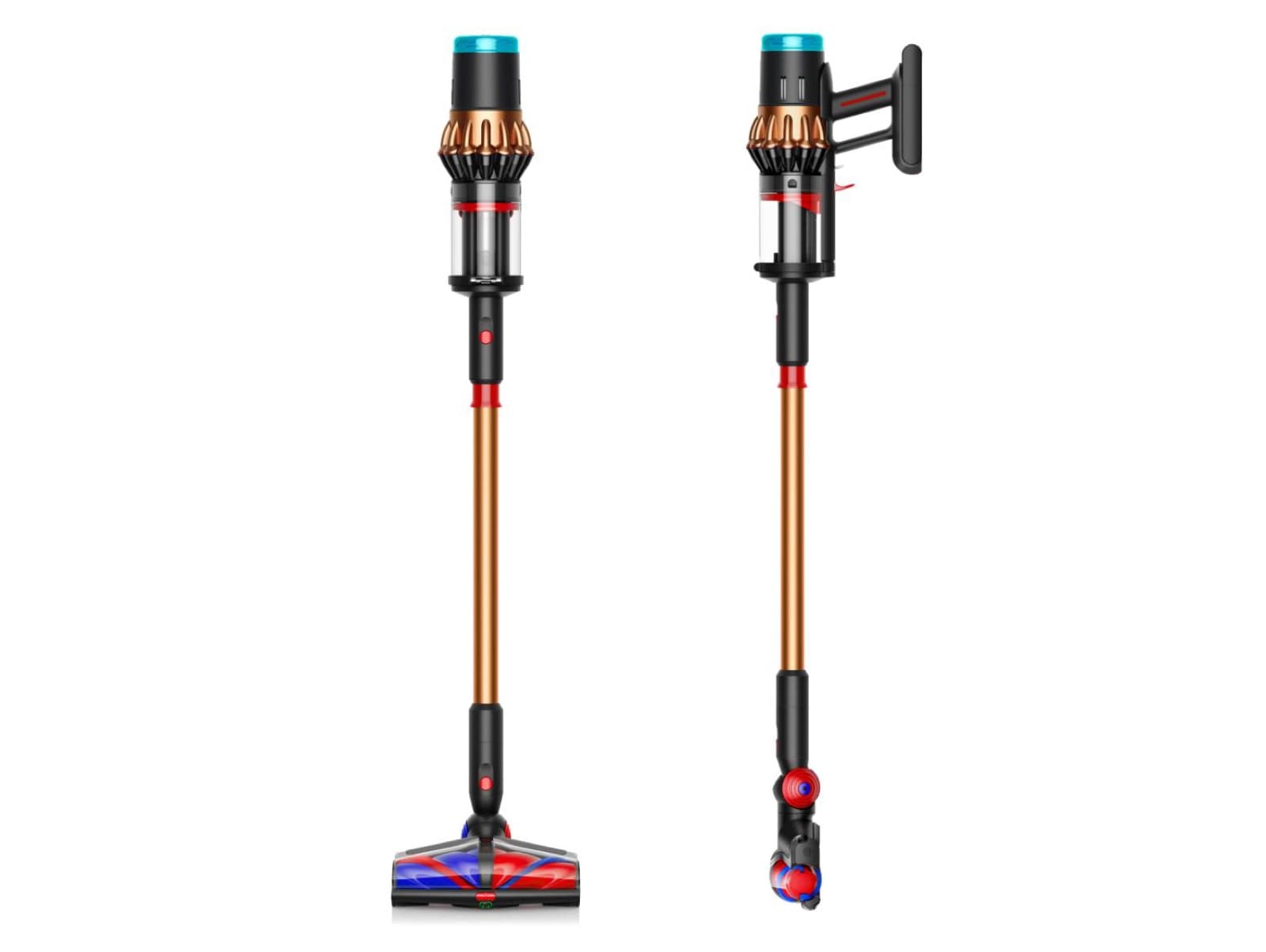
Power and pickup: Dyson takes the numbers
The Dyson V16 Piston Animal runs a 900W motor rated at 315AW in Boost mode, achieved partly by mounting the motor the opposite way round from previous machines. It is the most powerful cordless vacuum Dyson has built and, on raw suction, nothing in the Shark range answers it. That said, raw airwatts are not the whole story on carpet. The Shark PowerDetect Speed has repeatedly come top or joint top of cordless group tests on cleaning results, because its detection system adjusts power in real time rather than relying on brute force. Both machines are genuinely excellent on pet hair; only one of them wins on a spec sheet.
The intelligence race: cones versus four detectors
Dyson's answer is mechanical plus sensing. The All Floor Cones Sense head uses two conical anti-tangle brushrolls and a centrally mounted, low-angled laser, and the machine adjusts both suction and brushroll speed depending on the surface detected. Shark's answer is PowerDetect Intelligence, four separate systems working together: Floor Detect, Edge Detect, Dirt Detect and Direction Detect. It boosts near skirting boards, ramps up when it finds a dirty patch and eases off when you pull backwards. Shark also added Reveal for 2026, a precision-angled cyan beam that highlights dust on hard floors and automatically reverts to white light on carpet. Different routes, similar outcome: you stop touching the power button.
Emptying: the Shark's trump card
This is where the comparison is decided for a lot of households. The Shark PowerDetect Speed's flagship variant ships with an Auto-Empty Base that pulls the contents of the 0.5-litre onboard bin into a sealed two-litre container, which Shark rates at up to 45 days between emptyings, with an anti-odour cartridge and storage for attachments. The Dyson V16 Piston Animal counters with the CleanCompactor: a lever that physically compresses debris and a slider that wipes fine dust off the casing, giving roughly 30 days of capacity. Dyson has confirmed a self-empty dock is coming for the V16, but it is not in the box today. Shark's dock is noisy for about thirty seconds after each clean.
Weight, handling and living with them
The Shark PowerDetect Speed weighs around 3.5kg and is deliberately slimmer than earlier PowerDetect models, with the Flexology wand that bends in the middle so you can reach under sofas without kneeling. That combination makes it the friendlier machine for anyone with limited mobility. The Dyson is lighter than the Gen5detect it replaces — it matches the V15 Detect — but is still a meaningful weight at head height, and Dyson's counter-trick is different: the angled docking tube lets you swap floorheads while standing upright, using a release cuff at the top of the wand. Both have an onboard screen; Shark's shows Dirt Detect working in real time but reports battery as an icon rather than a percentage.
Battery, charging and the wet-floor question
Shark quotes around 60 minutes in Eco mode, but published testing has been blunt about the other end: less than eleven minutes on the highest power setting, and a recharge that takes five to six hours. Dyson's cyclone management helps here — in Eco and Auto modes half the cyclones close off via a rubber valve, extending filter life and efficiency. For wet floors, the Dyson V16 Piston Animal offers a Submarine version with the Submarine 2.0 head, a 300ml tank and a rated coverage of about 110 square metres, though reviewers note the small tanks and leak-prone dirty-water compartment were not fixed. Shark's answer is a separate Pet Edition with the FurFins tool, sold only in the UK.
Who should buy which
Buy the Dyson V16 Piston Animal if you have thick carpets, pets and a house big enough that suction genuinely matters, if you want the strongest cordless machine on sale in Europe, and if the compacting bin plus one all-floors head solves your actual annoyances. Buy the Shark PowerDetect Speed if you want to stop thinking about vacuuming entirely: the dock empties it, the sensors drive it, the wand bends under furniture and it is lighter to carry upstairs. In value terms Shark wins comfortably. In engineering terms Dyson does. In a flat with hard floors and a hallway cupboard, Shark is the smarter buy.
Consumables, spares and the cost of ownership
Neither machine is finished once you have paid for it. Both use washable filters that need rinsing and drying properly, and both sell replacement brushrolls, filters and batteries as spare parts across UK and European retailers. Shark's Auto-Empty Base adds an anti-odour cartridge to the list of things you will eventually reorder. Dyson's compacting bin avoids a bag consumable entirely, which is the quiet cost advantage nobody mentions in reviews. Both carry the two-year legal warranty European buyers are entitled to, with extended manufacturer cover available on registration. If you are choosing between them on total outlay rather than purchase price, Dyson's spares are dearer but its accessory ecosystem is deeper, and its older machines hold resale value noticeably better.
Pros
Cons
Comparison
Dyson V16 Piston Animal
315AW from a 900W motor, a compacting bin worth about 30 days, one all-floors cone head and stand-up attachment swapping. No auto-empty dock in the box, and it costs more.
Shark PowerDetect Speed
Around 3.5kg with a bending Flexology wand, four detection systems, Reveal dust lighting and an Auto-Empty Base rated to 45 days. Weak on maximum-power runtime and slow to recharge.
FAQ
Both are good and neither is perfect. Dyson's twin cone rollers push hair toward the narrow end to be sucked away, but strands can lodge behind the roller. Shark uses a self-cleaning brushroll that reviewers rate highly for tangle resistance.
If you judge vacuums by engineering, the Dyson V16 Piston Animal wins: more suction, cleverer bin, better floorhead concept. If you judge them by how little you have to think about cleaning, the Shark PowerDetect Speed wins, and it costs less doing it. Carpets and pets point to Dyson. Hard floors and a small flat point to Shark.