Philips OLED+951 vs LG G6: Europe's Flagship OLED Question
Two flagship OLEDs, two panels built on the same underlying Primary RGB Tandem idea, two very different ways of spending your money. The LG G6 is the global default: enormous app support, unbeatable gaming credentials, a design that hangs flush to the wall. The Philips OLED+951 is the European specialist: lights that spill across the room, a sound system that does not embarrass itself, and HDR support the LG simply does not have. Here is how they actually differ.
Panels and brightness: close cousins, different claims
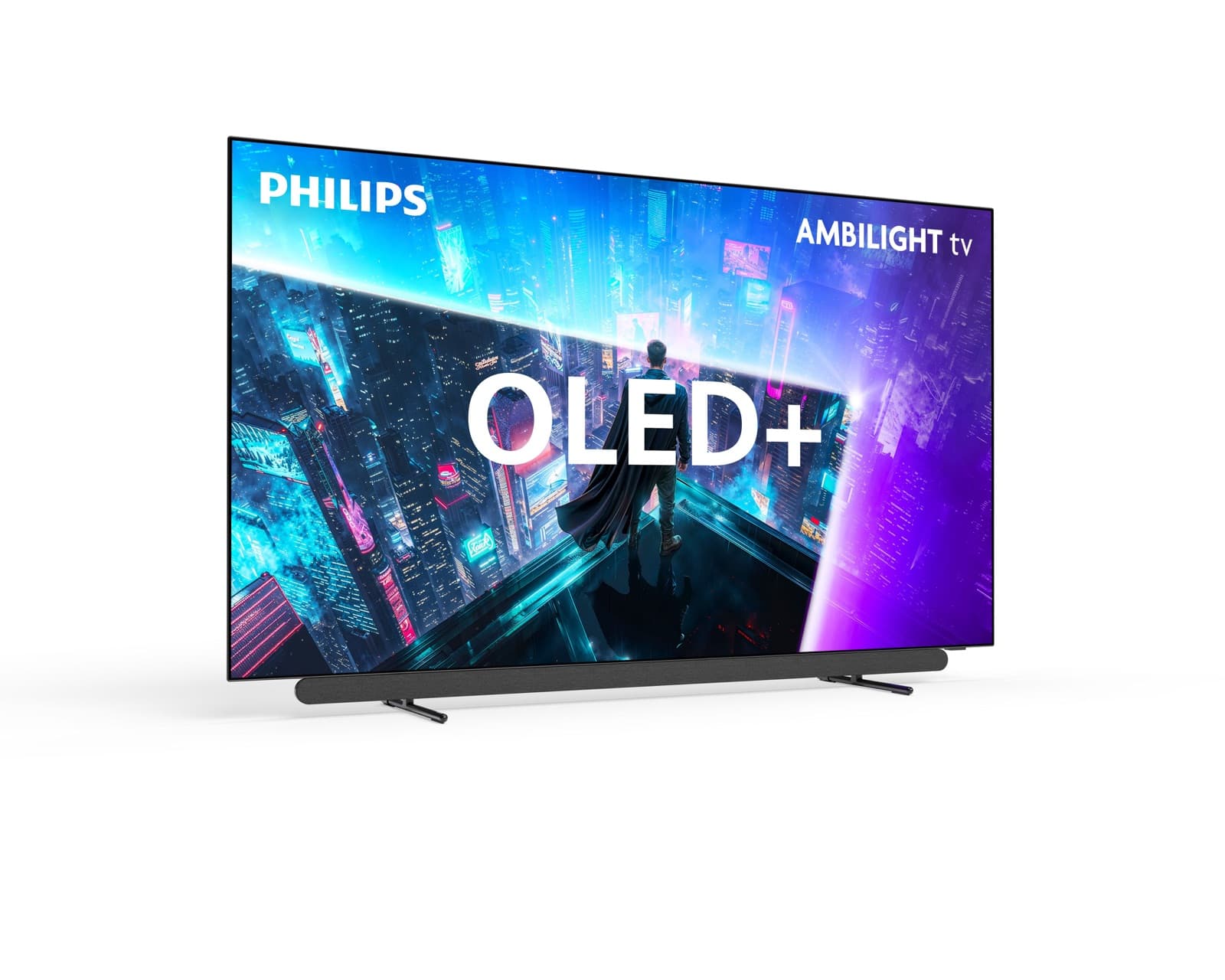
Both sets use the latest generation of the Primary RGB Tandem OLED structure, the four-stack panel design that replaced micro lens array and closed much of the colour-volume gap to QD-OLED. Philips quotes the OLED+951 at up to 4,500 nits peak with a META 4.0 Primary RGB Tandem 2.0 panel. LG does not publish a comparable headline figure but claims roughly 20 per cent higher peak brightness than the G5 thanks to Hyper Radiant Colour Technology in its Alpha 11 Gen 3 processor. Reviewers confirm the LG G6 is visibly brighter and more nuanced than its predecessor, with better skin tones and restrained, accurate colour in Filmmaker Mode. Comparable measured numbers for the Philips are not yet published.
HDR formats: the one real spec gap
This is where the two diverge properly. The Philips OLED+951 is among the first televisions anywhere to ship Dolby Vision 2 Max, alongside Dolby Vision, HDR10, HDR10+ and HLG — genuinely everything. The LG G6 supports Dolby Vision, HDR10 and HLG, but not HDR10+ and not Dolby Vision 2. LG has hinted an update might arrive; it has not committed. Be honest about what this means today: almost no content is mastered in Dolby Vision 2, so nothing on your watchlist is affected right now. It only matters if you keep televisions for five years or more, which at flagship money most people do. HDR10+ support is the more immediately useful difference, because Prime Video uses it.
Ambilight, AmbiScape and the room itself
The Philips has a feature the LG cannot answer. Four-sided Ambilight throws colour matched to the picture onto the wall behind the screen, and for 2026 AmbiScape extends that to up to four compatible smart bulbs — Philips Hue, IKEA and Nanoleaf included — so the whole room reacts. It is polarising. Film purists switch it off within a week; sports and gaming households swear by it. LG's counter is design rather than light: the Gallery format sits essentially flush against a wall with the Zero Gap mount, and the 55- and 65-inch models can be bought with a pedestal stand instead. Both approaches are about how the set lives in a room, not how it looks on a test bench.
Smart platforms: webOS 26 versus TitanOS
LG wins this comfortably, and it is the strongest practical argument for the G6. webOS 26 carries effectively every app anyone asks for, from Netflix, Disney+ and Prime Video down to niche services such as Crunchyroll and Hidive, and it is a mature, well-supported platform. Philips has moved its flagships off Google TV to its own TitanOS, which is lighter and less cluttered but a smaller ecosystem, and Apple TV was a notable initial omission that Philips committed to adding during the year. If your household depends on casting, Google Assistant or an obscure regional streamer, check the TitanOS catalogue carefully before buying.
Gaming and connections: effectively a tie
Both sets finally have four full-bandwidth HDMI 2.1 sockets — Philips got there via the MediaTek Pentonic 800 chipset, joining LG and Samsung. Both support variable refresh rate and auto low latency mode across all four inputs. Both top out at 4K/165Hz. LG adds Dolby Vision game mode and HGiG support, plus new game-streaming features including a low-latency interface and an optional controller developed with Razer. Philips brings HDR10+ Gaming and its usual FreeSync support. For a PS5, Xbox Series X or a high-refresh PC, either is fully specified. LG's gaming software layer is the more polished of the two, as it has been for several generations.
Sound, sizes and who should buy which
Built-in audio is a real win for Philips. The OLED+951 carries a 70W 2.2-channel system with two bass drivers replacing the OLED950's single woofer, and reviewers have consistently rated recent Philips flagships above LG's G-series, which remains thin and bass-light despite improvements. Sizes differ too: the Philips comes in 65 and 77 inches only, while the LG G6 spans 55, 65, 77 and 83. Buy the LG G6 if you want the most complete, best-supported flagship and the finest gaming platform, or if you need a 55- or 83-inch screen. Buy the Philips OLED+951 if you want Ambilight, every HDR format going and sound you can live with before the soundbar arrives.
Availability, reviews and when to buy
Timing matters more than usual this year. The LG G6 has been through a full review cycle, including a round of software updates that measurably improved colour accuracy, contrast and dark detail after launch — a reminder that first verdicts on modern televisions are provisional. The Philips OLED+951 reached shops with the 65-inch first and the 77-inch following in September, and independent measured reviews remain scarce, so early buyers are trusting the specification. Meanwhile 2025 flagships from both brands are being cleared at steep reductions. If you can wait until the autumn sales cycle, do; if you cannot, the LG is the better-understood purchase and the Philips is the more interesting gamble.
Pros
Cons
Comparison
Philips OLED+951
Every HDR format including Dolby Vision 2 Max, four-sided Ambilight with AmbiScape, a genuinely capable 70W 2.2 sound system. Only 65 and 77 inches, and TitanOS is a smaller ecosystem.
LG G6
The most complete flagship: webOS 26 app support, superb gaming features across four HDMI 2.1 ports, four screen sizes and a flush Gallery design. No Dolby Vision 2, no HDR10+, weak built-in audio.
FAQ
Barely, today. Almost no content has been mastered in the format yet, so neither set will show you a difference this year. It is longevity insurance, which is a fair thing to want at flagship prices.
The LG G6 is the safer flagship: better software, more sizes, superb gaming, sold everywhere. The Philips OLED+951 is the more interesting one, with the full HDR set, sound that works and a light show nobody else offers. If your television is a film-and-football centrepiece in a European living room, the Philips deserves the shortlist spot most guides do not give it.