adidas in Europe: The Current Line-Up, Model by Model
adidas currently sells one of the deepest footwear ranges in Europe, and it is genuinely confusing: two daily-trainer families, a performance line with six members, and a terrace archive that has been carrying the brand's fashion business for three years. The good news is that the logic underneath is consistent. Once you know what each foam does, the whole line-up resolves into a ladder from easy miles to world records. Here is the current European range, model by model, with what to buy and what to leave.
The foams, because everything follows from them
adidas runs four midsole compounds and one structural element, and the model names map onto them almost perfectly. Dreamstrike+ is the PEBA-based superfoam used across the Supernova family — soft, lively and considerably lighter than standard EVA, aimed at everyday training. Lightstrike Pro is the TPEE racing foam used throughout Adizero, made without compression moulding so it returns more energy at lower weight. Lightstrike 2.0 is the durable EVA carrier that sits underneath it in training shoes. LightBoost V2 is the updated, softer Boost used in the Ultraboost. And EnergyRods are glass-fibre or carbon rods embedded in Adizero performance shoes, providing propulsion and structure without a flat plate. Know those five names and you can read any adidas spec sheet without help.
Daily trainers: Supernova Rise 3, Supernova Prima 2, Ultraboost 5X
The Supernova family is where most runners should start. The adidas Supernova Rise 3 is the accessible one: a full Dreamstrike+ midsole, a 10 mm drop and a breathable Primeweave upper, with reports of the lateral heel outsole wearing faster than expected on the lighter Lighttraxion rubber. The adidas Supernova Prima 2 is the better shoe and the one to buy for long runs — more stack, a softer and more responsive forefoot, full-length support rods and a genuinely premium upper, on an 8 mm drop. The adidas Ultraboost 5X sits apart from both: LightBoost V2 foam, a Continental rubber outsole, a 10 mm drop and a sock-like Mono Primeknit upper. Reviewers split hard on it, and the fair read is that it is adidas's most comfortable shoe rather than a serious trainer.
The max-cushion outlier: Hyperboost Edge
The adidas Hyperboost Edge is the newest and most cushioned daily trainer in the range, and it uses a foam that appears nowhere else: Hyperboost Pro, a pelletised supercritical EPEBA compound tuned for comfort and durability rather than for racing. It runs an 8 mm drop with a full-coverage Lighttraxion outsole. The midsole earns consistent praise for being both responsive and hard-wearing, which is an unusual combination at this stack height. The upper is the problem, and opinions on it are unusually polarised — Primeweave with TPU overlays reads as secure and premium to some runners and as unwearable to others, depending entirely on foot shape. Try it on. If it fits you, it is one of the most cushioned and energetic daily trainers adidas has built.
Adizero performance: SL 2, Evo SL, Evo SL EXO, Boston 13
This is the strongest part of the range. The adidas Adizero SL 2 is the entry point, with a full-length Lightstrike Pro midsole over Lightstrike 2.0 on an 8 mm drop — superfoam in a genuinely affordable daily trainer, though it runs narrow through the heel. The adidas Adizero Evo SL is the star: roughly 224 g in a UK 8.5, a 39 mm heel, a 33 mm forefoot and a 6 mm drop, with no plate, which makes it the most versatile shoe adidas sells. Reviewers rate it among the best shoes of the past year, with two consistent complaints — the tongue slides sideways and the midfoot is wide. The Evo SL EXO answers the second with a reinforced exoskeleton upper. The adidas Adizero Boston 13 is the firmer, snappier tempo alternative, with glass-fibre EnergyRods and a 10 mm drop.
Race day: Takumi Sen 11, Adios 9, Adios Pro 4, Adios Pro Evo 3
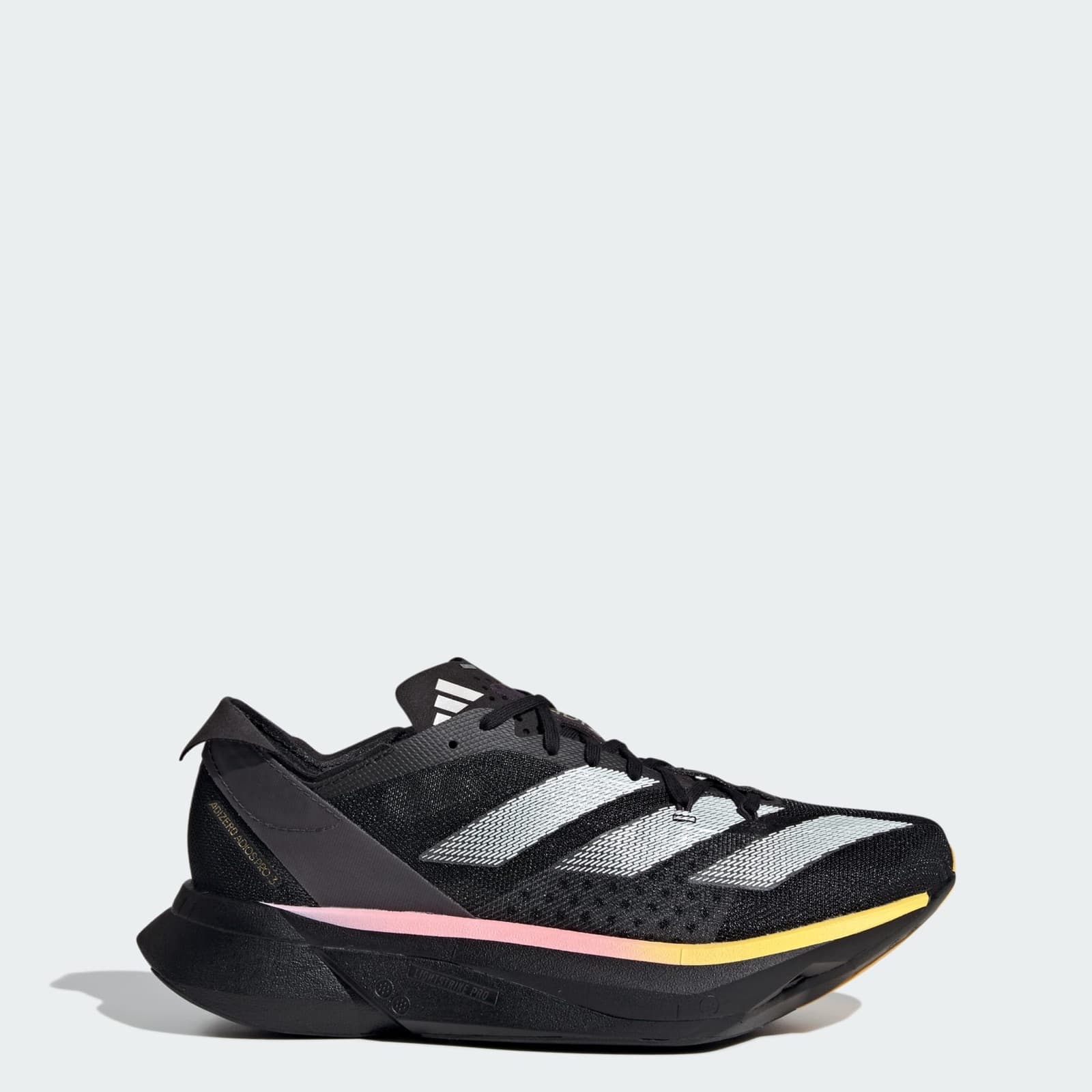
Four racers, four distances. The adidas Adizero Takumi Sen 11 is tuned for 5K and 10K, with dual Lightstrike Pro layers, glass-fibre EnergyRods and a sharper rocker than its predecessor. The Adizero Adios 9 is the minimal flat: pure Lightstrike Pro with a nylon shank, a 5 mm drop and no carrier foam at all, built for track work and short road racing. The adidas Adizero Adios Pro 4 is the marathon shoe, re-engineered softer than version 3 with carbon Energy Rods 2.0 and a LIGHTLOCK heel band — a change that divided long-time fans. Above all of them sits the adidas Adizero Adios Pro Evo 3, launched in a limited European drop on 25 April 2026 at under 100 grams with a 39 mm stack, and a wider release timed to the autumn marathon season.
The terrace side: Samba OG, Handball Spezial and the flat shoes
adidas's fashion business in Europe currently rests on a handful of archive shapes, and the adidas Samba OG leads it. Genuine leather with real suede overlays on a gum cup sole, around 335 g, true to size, and rated among the most durable leather sneakers in abrasion testing — with a narrow toebox and a gum outsole that measures low for traction. The adidas Handball Spezial is the suede alternative at roughly 344 g, slightly friendlier in fit and slightly less saturated. Alongside them, the Gazelle, SL 72 and Tokyo cover the same low-profile territory in different proportions, which is the dominant sneaker silhouette across Europe in 2026. Style guides now routinely publish lists of alternatives to the Samba, which tells you how thoroughly it has been adopted.
What to buy, what to skip
Buy the adidas Adizero Evo SL if you want one running shoe to cover everything, or the Evo SL EXO if you need better lockdown. Buy the Supernova Prima 2 for easy days and long runs, and the Adizero Boston 13 if you want a dedicated tempo trainer. Race short in the Takumi Sen 11, race long in the Adios Pro 4. Skip the Adizero Adios Pro Evo 3 unless you are chasing a personal best and can accept a narrow, fragile, hard-to-find shoe. Skip the Supernova Rise 3 if you can stretch to the Prima 2, which is a clear step up. And treat the Ultraboost 5X as a lifestyle purchase rather than a training one — its own reviewers effectively concede the point.
Comparison
adidas Adizero Evo SL
The best all-round shoe adidas sells: full Lightstrike Pro, a 39 mm heel, a 6 mm drop, roughly 224 g and no plate. Easy days, long runs and speedwork all covered.
adidas Supernova Prima 2
The premium daily trainer, with a softer Dreamstrike+ forefoot, full-length support rods and an 8 mm drop. The sensible long-run shoe for most European runners.
adidas Adizero Adios Pro Evo 3
The halo racer: under 100 grams with a 39 mm stack, ENERGYRIM carbon structure and Continental forefoot rubber. Narrow, fragile and limited in supply.
adidas Hyperboost Edge
The max-cushion daily trainer built on pelletised supercritical EPEBA, with an 8 mm drop. Excellent midsole, deeply polarising upper — worth trying in person first.
adidas Samba OG
Leather and suede on a gum cup sole at roughly 335 g. Outstanding durability and total versatility, undermined by a narrow toebox and genuinely slippery wet traction.
adidas Adizero Boston 13
The dedicated tempo trainer: Lightstrike Pro over Lightstrike with glass-fibre EnergyRods, a 10 mm drop and a firm, purposeful ride. Runs about half a size small.
FAQ
Lightstrike Pro is the TPEE racing foam used across Adizero, made without compression moulding for maximum energy return. Dreamstrike+ is the PEBA-based daily-training foam used in the Supernova family, tuned for comfort and durability.
adidas's European range is deep but not confusing once the foams make sense: Dreamstrike+ for comfort, Lightstrike Pro for speed, LightBoost for lounging. The Adizero Evo SL is the single best thing the brand makes, the Supernova Prima 2 is the sensible long-run buy, and the Samba OG remains the most useful non-running shoe in Europe. Skip the halo racer unless you race.