Dyson in 2026: Every Machine in the European Lineup
Dyson used to release one significant machine a year and let everyone argue about the price. In September 2026 it announced twelve at once, in Berlin, under a banner describing a new era of intelligent machines. The engineering pitch has shifted: where the company once sold motors and cyclones, it now sells sensors, vision systems and machine learning wrapped around them. Here is the whole European lineup, what each machine actually does, and which ones are worth the money.
The strategy shift, in plain terms
Chief engineer Jake Dyson framed the 2026 announcements around a move from purely mechanical devices to machines that can sense, interpret and respond to their surroundings — the same approach applied whether the product is working in your mouth, on your hair or across your floor. In practice that means cameras, lidar, ultraviolet light and neural networks appearing in categories that previously relied on airflow alone. It is a defensible direction, because Dyson's historic advantage in motor design has been eroded by rivals, and because the things that irritate people about vacuuming are increasingly about automation rather than suction.
Cordless: the V16, the PencilVac and the V8
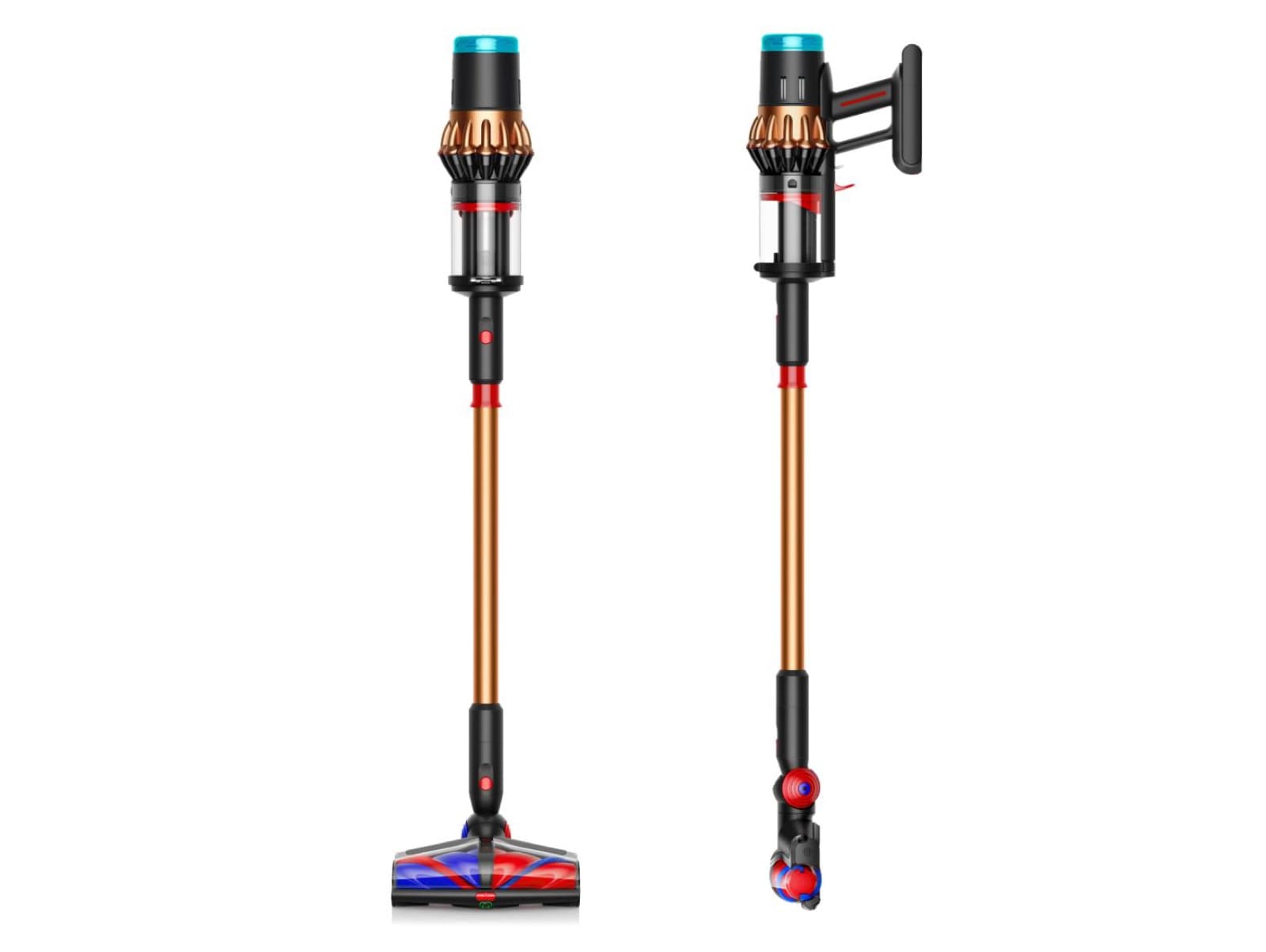
Three machines cover three households. The Dyson V16 Piston Animal is the flagship, with a 900W motor rated at 315AW, a compacting CleanCompactor bin holding roughly 30 days of debris, an All Floor Cones Sense head with twin anti-tangle cone rollers and attachment swapping you can do standing upright. The Dyson PencilVac is the opposite: a body just 38mm across, under two kilos, a motor spinning near 140,000rpm, four conical soft rollers and twin dust-revealing lasers, brilliant on hard floors and poor on carpet. Below both, the Dyson V8 Cyclone refreshes the classic compact with roughly 30 per cent more suction at around 150AW, runtime up to 60 minutes and a triggerless power button.
Robots: from Viznav to Nurovi
Dyson's robot strategy has been rebooted twice in quick succession. The Dyson Spot+Scrub Ai replaced the 360 Viznav with the company's first proper multi-function dock, using cyclonic separation into a two-litre bagless bin, a continuously rinsed microfibre roller mop that extends past the robot's edge, carpet detection that lifts the roller, and Dyson's first obstacle avoidance recognising around 200 common objects. Navigation finally moved to lidar. Then, at Dyson Unveiled in Berlin on 4 September 2026, three Nurovi robots arrived: the R1 Nurovi Dry, the R2 Nurovi Wash+Dry with 75-degree water and Reuleaux-triangle pads that reach into corners, and the flagship Dyson R3 Nurovi Spot+Scrub UV, which combines ultraviolet light, AI vision and green laser illumination to find and re-scrub stains, due early 2027.
Wet floor care and the hygiene problem
Dyson's argument in this category is about what happens to dirty water, and it is a good one. Most floor washers recirculate dirty water through internal filters, which becomes unpleasant quickly. Dyson's designs feed clean water continuously to an absorbent microfibre roller and route the dirty water straight into a waste compartment in the floor head instead of back through the machine. The Clean+Wash Hygiene adds a dock that washes the roller and dries it with heated air at around 85 degrees, at a relatively light 8.4lb. The Dyson W1 PencilWash extends the slimline concept to mopping with a more absorbent roller, a new hygienic waste system and a dock that doubles as a cleaning station.
The corded comeback nobody expected
The most charming announcement of 2026 was the return of a format everyone assumed was dead. The Dyson Big Ball Konical revives the cylinder vacuum, complete with a visual nod to the colourway of the original DC01 De Stijl, and adds a green laser-like light to illuminate dust plus the self-righting Ball design that made the format tolerable in the first place. It is a reminder that corded machines still make sense for people who want unlimited runtime and consistent suction rather than battery management. Dyson also confirmed a V15 Konical cordless for 2027, and a self-empty docking station for the V16 and the refreshed V8 Cyclone — the one obvious gap against Shark today.
Air, teeth and hair: the rest of the range
Floor care is only part of the business. The Dyson HushJet Purifier Compact borrowed aerospace thinking for a star-shaped nozzle that smooths exiting airflow, rating it at 24 decibels in sleep mode while claiming up to 80 per cent of the cleaning capacity of Dyson's large purifiers in around a third of the size, with fully sealed HEPA and activated carbon filtration plus particle and volatile compound sensors. Three larger HushJet models followed in Berlin, led by the Big+Quiet Cool Pure+Formaldehyde. Elsewhere the range now includes the CameraJet toothbrush with a camera in the head, the Corrale CoolShine and Airsmooth in haircare, and a Plum and Copper colourway across the hair range.
What to buy now, what to wait for
Buy the Dyson V16 Piston Animal if you have carpets, pets and a house; it is the most capable cordless machine on sale in Europe and the compacting bin genuinely changes the routine. Buy the Dyson PencilVac only if your floors are hard and your expectations are modest. Buy the V8 Cyclone as an affordable second machine. Wait if you want a robot: the Nurovi line lands from 2027 and the R2 Nurovi Wash+Dry looks like the sensible one, since the flagship R3 is a 2027 proposition with no European pricing yet. And if the missing auto-empty dock bothers you, waiting is the rational move.
Pros
Cons
Comparison
Dyson V16 Piston Animal
The cordless flagship: a 900W motor rated at 315AW, a compacting bin worth about 30 days of debris, one all-floors cone head and stand-up attachment swapping. No auto-empty dock yet.
Dyson PencilVac
The ultra-slim hard-floor machine, 38mm across and under two kilos, with four conical soft rollers, twin lasers and HEPA filtration. Weak on carpet and short on maximum-power runtime.
Dyson V8 Cyclone
The refreshed compact: roughly 30 per cent more suction at around 150AW, runtime up to 60 minutes and a triggerless power button. The sensible second machine for stairs and cars.
Dyson Spot+Scrub Ai
Dyson's first robot with a multi-function dock, using cyclonic separation into a bagless bin, a rinsed roller mop, carpet lifting, lidar navigation and avoidance of around 200 object types.
Dyson R3 Nurovi Spot+Scrub UV
The flagship robot announced in Berlin for early 2027, pairing ultraviolet light, AI vision and green laser illumination to detect stains and re-scrub them with 70-degree heated water.
Dyson W1 PencilWash
A slimline wet cleaner with a more absorbent roller and a hygienic waste system that routes dirty water away from the machine, with a dock that doubles as a cleaning station.
Dyson Big Ball Konical
The cylinder vacuum returns, with a visual nod to the original DC01 De Stijl colourway, a green dust-illuminating light and the self-righting Ball design. Unlimited runtime, no battery anxiety.
Dyson HushJet Purifier Compact
A small purifier rated at 24 decibels in sleep mode, claiming up to 80 per cent of the cleaning capacity of Dyson's large models, with sealed HEPA, carbon filtration and live air-quality sensors.
FAQ
The V16 Piston Animal if you have carpet and pets, since it combines the strongest suction available with a bin that needs emptying roughly monthly. For hard floors and small flats, the PencilVac or the cheaper V8 Cyclone make more sense.
Dyson's 2026 range is the broadest it has ever offered and the most software-dependent. The V16 Piston Animal is the machine to buy today, the Big Ball Konical is the most charming, and the Nurovi robots are the ones that will decide whether Dyson becomes competitive in the category it has repeatedly failed to crack.