Philips TVs in Europe 2026: The Full Ambilight Lineup
Philips is the odd one out in European television. Its sets are built by TP Vision under licence, sold across Europe and largely absent everywhere else, and they have one feature nobody has ever successfully copied. For 2026 the range has been rebuilt from the panel up: a new Tandem OLED generation, Dolby Vision 2, the brand's first RGB Mini LED, a 100-inch screen and a wholesale move off Google TV. Here is the lineup, model by model.
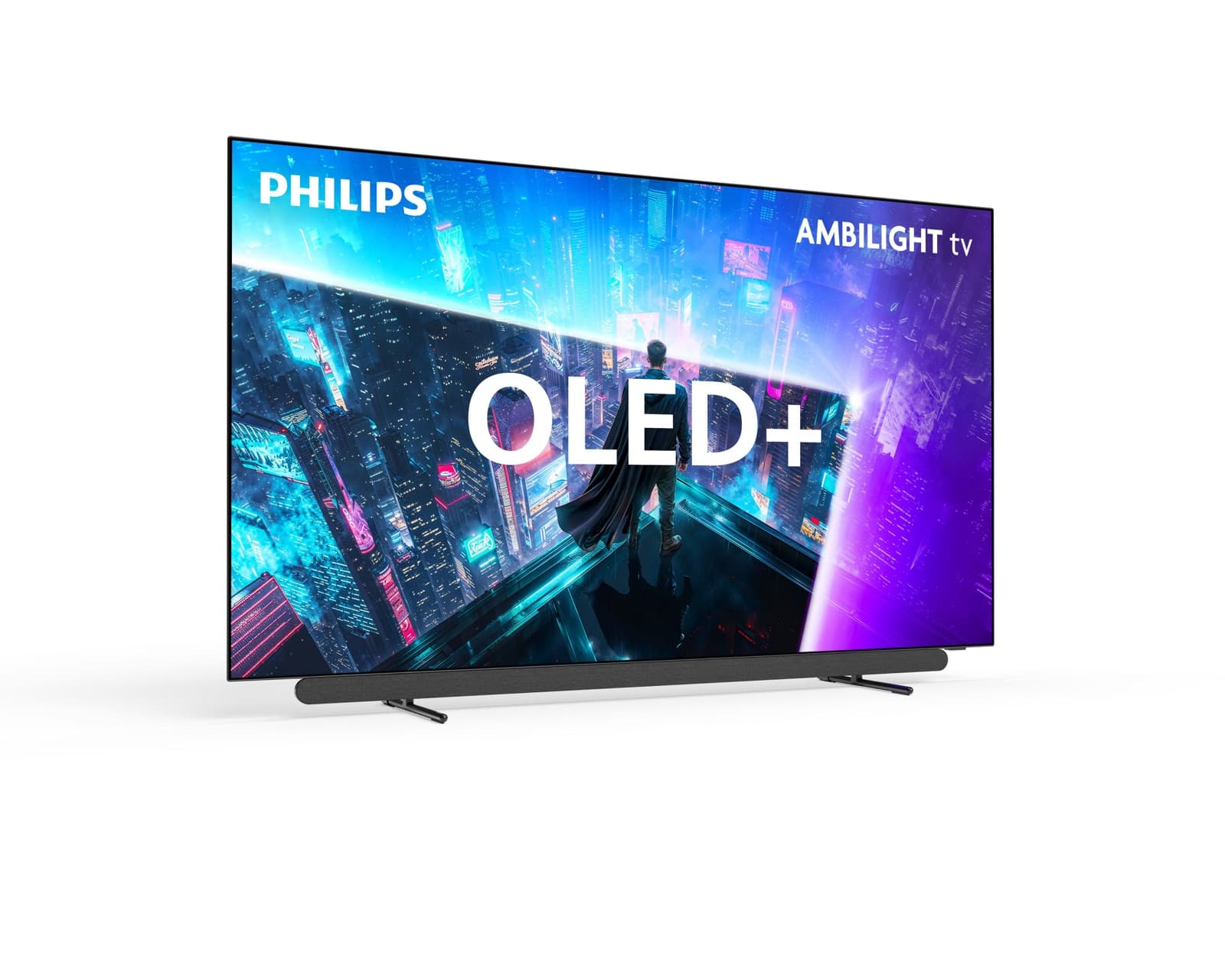
What Philips means in Europe now
Worth clearing up before you shop. The Philips name on a television in Europe belongs to TP Vision, part of TPV Technology, which licenses the brand from Koninklijke Philips. The same name on a lightbulb belongs to Signify, and on a coffee machine to Versuni. That fragmentation confuses buyers, but it matters less than it sounds, because the television business has a clear identity of its own: Ambilight, competitive pricing against LG and Samsung, and a habit of putting genuinely good sound systems into its flagships. Six premium series make up the 2026 range, and every single one carries Ambilight with the new AmbiScape extension.
The flagships: OLED+951 and OLED+911
The Philips OLED+951 is the range-topper, in 65 and 77 inches, combining a META 4.0 Primary RGB Tandem 2.0 WOLED panel quoted at up to 4,500 nits with a dual-processor 10th Gen P5 AI engine, Dolby Vision 2 Max, four-sided Ambilight, four HDMI 2.1 ports and 165Hz variable refresh. Its 70W 2.2 sound system replaces the old single woofer with two smaller bass drivers. The 65-inch version took an EISA premium OLED award for 2026 to 2027. Alongside it, the Philips OLED+911 offers the same panel generation and Dolby Vision 2 Max but with the Bowers & Wilkins partnership intact: an 81W 3.1-channel bar built into the chassis with left, centre and right channels, a rear bass enclosure and an external subwoofer output. It spans 48 to 77 inches and won a Red Dot design award.
The one most people should buy: OLED811
The 800 series has long been the smart purchase in the Philips range, and the Philips OLED811 continues that. It uses higher-output OLED EX panels rather than Tandem, quoted at 2,500 nits on the 55-, 65- and 77-inch models with 98.5 per cent DCI-P3 coverage, but pairs them with the same 10th Gen P5 AI processor and MediaTek Pentonic 800 chipset as the flagships. That means four HDMI 2.1 connectors, 165Hz refresh, HDR10+ Gaming, FreeSync Premium and G-Sync compatibility, and Dolby Vision 2 Max. Three-sided Ambilight with AmbiScape is included, sound is a 70W 2.2 system dropping to 50W on the 42-inch, and the 55-inch model took an EISA Best Buy OLED award. It launched from June through September across 42 to 77 inches.
Entry OLED without the entry compromises: OLED761
The Philips OLED761 exists to put perfect blacks and Ambilight within reach of people who were never going to spend flagship money. It uses LG Display's more affordable OLED SE panel with a quoted 1,000-nit peak and the step-down 7th Gen P5 AI processor, which is a real drop in processing muscle rather than a marketing distinction. What it keeps matters, though: three-sided Ambilight with AmbiScape, four HDMI 2.1 sockets supporting 4K/120Hz with variable refresh and auto low latency, HDR10+ Gaming, FreeSync Premium and G-Sync compatibility, plus IntelliSound automatic profile switching. Sizes run 55, 65 and 77 inches, arriving between June and October. Its predecessor was widely praised as exceptional value for an OLED.
Beyond OLED: MLED981 and PQS9001
Two models cover the ground OLED cannot. The Philips MLED981 is the brand's first RGB Mini LED television, an 85-inch set arriving in October with an 11,520-zone backlight, a quoted 2,500-nit peak, 97 per cent BT.2020 coverage, Dolby Vision 2 Max and a 70W 4.1 sound system using two down-firing and two side-firing drivers plus a rear subwoofer. Philips deliberately positions it below even the entry OLED on picture quality, which is an unusually honest bit of range planning. The Philips PQS9001 is The One, the volume seller, now stretching across seven sizes from 43 inches to a 100-inch version that is the largest Ambilight television ever made. Core sizes arrived in June, with 85- and 100-inch models from October.
AmbiScape and TitanOS: the two big bets
Two software decisions define this range. AmbiScape is the good one: Ambilight now extends beyond the screen to up to four compatible smart bulbs, including Philips Hue, IKEA and Nanoleaf, so the whole room reacts to what is on. Crucially, it is standard across all six premium series rather than reserved for flagships. TitanOS is the risky one. Philips has dropped Google TV entirely in favour of its own platform, which carries Disney+, HBO Max, Netflix, YouTube and Prime Video, with Apple TV following in spring 2026, plus Google Assistant compatibility, Works with Alexa, AirPlay 2 and Control4. It is faster and less cluttered, but the app catalogue is smaller and that is a genuine consideration.
What to buy, what to skip
Buy the Philips OLED811 unless you have a specific reason not to — it takes the flagship processor, chipset, gaming specification and Dolby Vision 2 Max down to a far more sensible price, and spans the widest range of sizes. Stretch to the Philips OLED+911 if built-in sound matters, because the Bowers & Wilkins system genuinely removes the need for a soundbar. Take the Philips OLED+951 if you want maximum brightness and four-sided Ambilight. Skip the MLED981 unless you specifically need 85 inches and do not want OLED. And check the TitanOS app list against your household's actual streaming habits before ordering anything in this range.
Pros
Cons
Comparison
Philips OLED+951
The flagship, in 65 and 77 inches: META 4.0 Tandem 2.0 panel quoted at 4,500 nits, dual P5 processing, Dolby Vision 2 Max, four-sided Ambilight and a rebuilt 70W 2.2 sound system.
Philips OLED+911
The audiophile flagship, 48 to 77 inches, with an 81W Bowers & Wilkins 3.1 system built into the chassis, discrete left, centre and right channels and an external subwoofer output.
Philips OLED811
The value sweet spot: OLED EX panels at a quoted 2,500 nits, flagship-grade 10th Gen P5 processing, four HDMI 2.1 ports at 165Hz and Dolby Vision 2 Max, across 42 to 77 inches.
Philips OLED761
Entry OLED done properly: the affordable OLED SE panel at a quoted 1,000 nits, 7th Gen P5 processing, three-sided Ambilight with AmbiScape and four HDMI 2.1 sockets at 4K/120Hz.
Philips MLED981
Philips' first RGB Mini LED, an 85-inch October arrival with 11,520 dimming zones, 97 per cent BT.2020 coverage, Dolby Vision 2 Max and a 70W 4.1 sound system with rear subwoofer.
Philips PQS9001
The One, the volume QLED, now spanning 43 to 100 inches. Seventh Gen P5 processing, Dolby Vision 2, three-sided Ambilight and four extended-bandwidth HDMI connectors.
FAQ
The OLED811. It inherits the flagship 10th Gen P5 processor, the MediaTek Pentonic 800 chipset, four HDMI 2.1 ports at 165Hz and Dolby Vision 2 Max, while using a cheaper OLED EX panel and covering 42 to 77 inches.
Philips has had its most ambitious television year in a long time: a genuinely new panel generation, the first RGB Mini LED, a 100-inch Ambilight set and Dolby Vision 2 support nobody else in the OLED mainstream has. The OLED811 is the one to buy. TitanOS is the one thing to check carefully before you do.