Salomon in Europe: The Current Line-Up, Model by Model
Salomon occupies a strange position in Europe: a serious mountain-sports company that accidentally became a fashion brand, and is now quietly building one of the better road-running ranges nobody buys. The XT-6 pays the bills. The Aero Glide deserves more attention than it gets. And the Gore-Tex end of the catalogue is doing work no fashion label could imitate. Here is the current European line-up, model by model, running and sportstyle, with the lab numbers and the one fit warning that applies across the entire range.
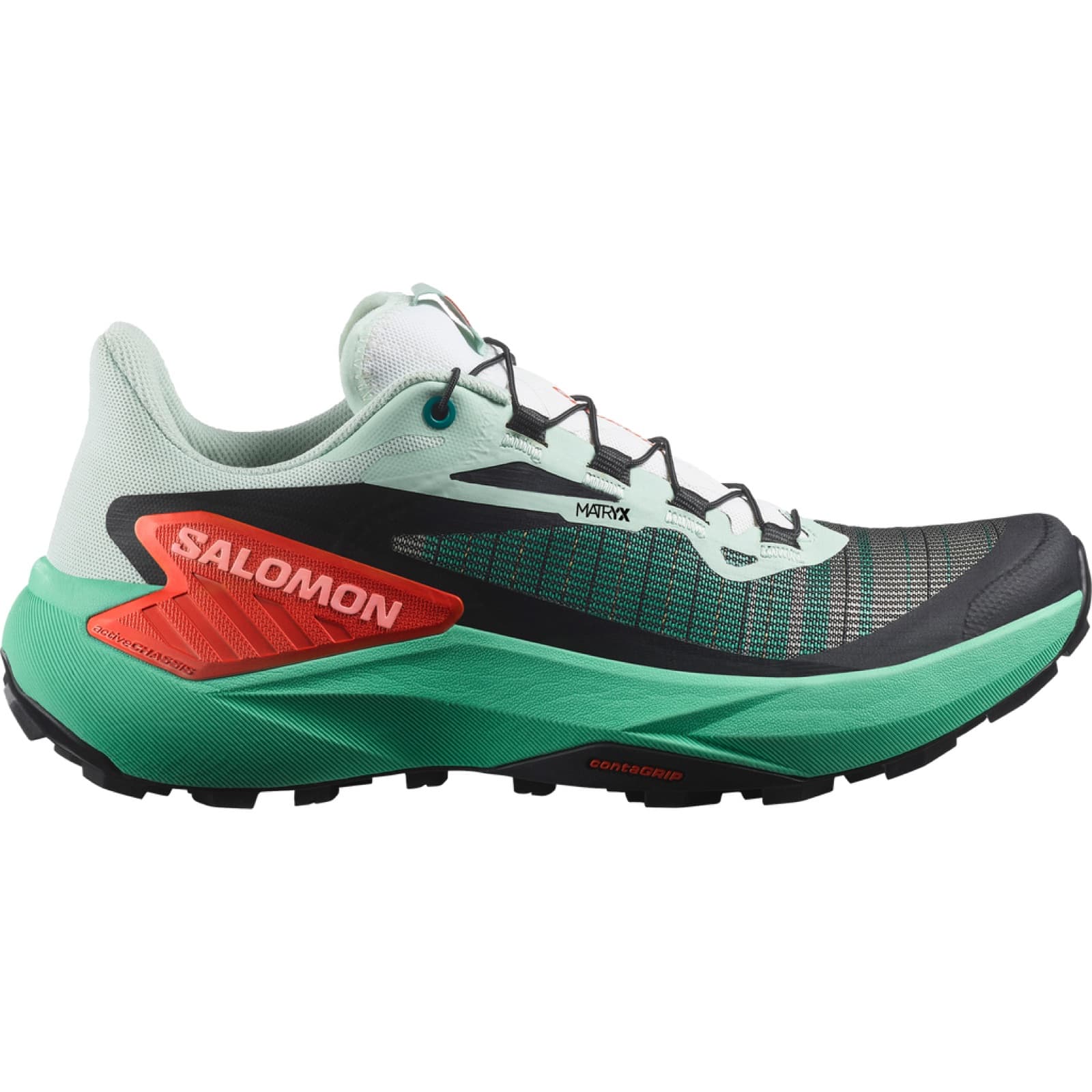
The technologies that define every Salomon
Five names recur across the catalogue. Contagrip is the outsole rubber, and it is genuinely good — every Salomon shoe put through standardised wet-traction testing has scored in the high band. Quicklace is the one-pull speed lacing that locks the midfoot evenly instead of in bands, and the Neo version appears on newer models. Matryx is an engineered mesh upper woven with Kevlar, breathable and light. The Advanced Chassis is a stiff TPU brace running from the midfoot around the heel, which stabilises the rearfoot and is particularly useful for runners whose heels collapse inwards. Sensifit connects that upper to the midsole for an enveloping hold. One number to remember: Salomon's average heel drop sits around 9.7 mm against an all-brand average nearer 8.3 mm, so the range runs high.
Trail: Genesis and Ultra Glide 4
The Salomon Genesis is the brand's most balanced trail shoe and the sensible starting point. A moderate 33.5 mm heel and 24.5 mm forefoot keep ground feel high, 4.0 mm multi-shaped lugs grip almost anything, and the Active Chassis guides the stride and reduces fatigue without making the shoe rigid — bend testing found it more flexible than average, which is unusual for a stabilised trail shoe. The forefoot measures low for shock absorption, so forefoot strikers who want protection should look elsewhere. The Salomon Ultra Glide 4 is that elsewhere: a taller 38.6 mm heel and 31.1 mm forefoot with wave-like relieveSPHERE midsole geometry, an aggressive rocker and a build measured as considerably stiffer than average, all aimed squarely at ultra distances.
Road: Aero Glide 4 and Aero Glide 4 GRVL
The Salomon Aero Glide 4 is the most overlooked road shoe in Europe. Lab measurement found a 43.2 mm heel and 31.5 mm forefoot against a category average nearer 35.5 and 27.1, with energy return of 72.2 per cent at the heel and 73.2 per cent at the forefoot — super-trainer territory — and shock absorption of 152 in the heel against a 131 average. It weighs roughly 255 g, which is light for that stack, and sits on a wide 121.7 mm landing base with supportive sidewalls. The catch is outsole durability, which measured below average. The Salomon Aero Glide 4 GRVL is the road-to-trail version: 2.3 mm lugs on Gravel Contagrip, a 40.9 mm heel, energy return above 73 per cent, far better abrasion resistance, and a winterproof upper that gets sweaty in heat.
Racing: S/Lab Phantasm 2 and S/Lab Spectur
The S/Lab line is where Salomon builds for its own athletes, and it shows in the details rather than the numbers. The Salomon S/Lab Phantasm 2 is a low-profile marathon flat: a 31.5 mm heel, a 26.4 mm forefoot, a 5.1 mm drop and roughly 213 g, with a Matryx upper, a smooth forefoot rocker and exceptional build quality, made in France. It measures well for shock absorption at 142 in the heel but disappointingly for energy return, and the narrow heel and low drop rule it out for rear strikers. The Salomon S/Lab Spectur is the plated option, with an energyBLADE carbon plate, a Reverse Camber rocker, PEBA foam, a 36.9 mm heel and the best traction figure in the range. Its energy return is also mediocre for the money.
Gore-Tex and all-weather: XA Pro 3D v9 GTX
The Salomon XA Pro 3D v9 GTX is the most protective shoe in the catalogue and the one that best explains why Salomon has a reputation at all. A Gore-Tex membrane blocks water and debris completely — so completely that permeability testing found it blocked light — and a toe bumper handles stubs. The ride is firm, with a durometer reading of 32.5 measured as considerably harder than average, but it dampens landings effectively rather than harshly. The 3D chassis delivers the highest torsional rigidity rating in the range, which means it resists rolling on uneven ground. It is heavy, it needs breaking in, and it lacks agility for technical trails, but as a hiking and foul-weather shoe it is very hard to beat in Europe.
Sportstyle: XT-6, XT-Evo and XT-MM6
This is the part of Salomon most Europeans actually buy. The Salomon XT-6 is a genuine trail shoe repositioned as unisex sportstyle: Agile Chassis System, dense AC Muscle foam, around 32 mm of stack including the insole, 5.5 mm Contagrip lugs and roughly 365 g on the scale. It fits true to size, grips superbly, resists abrasion and is firm enough to leave your feet sore on tarmac, stiffening further in cold weather. The Salomon XT-Evo arrived on 2 September 2026 as the first openly designated successor, keeping the chassis and Contagrip while wrapping a moulded TPU shell around the entire forefoot, in three launch colourways including a black-and-red nod to the 2013 original. The Salomon XT-MM6 is the Maison Margiela MM6 collaboration for anyone who wants the design-house version.
What to buy, what to skip, and the fit warning
Buy the Salomon Aero Glide 4 if you run on roads and want a cushioned long-run shoe nobody else in your club owns. Buy the Genesis for general trail use and the Ultra Glide 4 if your races are very long. Buy the XA Pro 3D v9 GTX for winter hiking. Buy the XT-6 for the street, or the XT-Evo if you want the newer shape. Skip both S/Lab racers unless you specifically want French-made construction and Matryx quality, because their energy return does not justify the price against modern super shoes. And the warning that applies to everything: Salomon's average width and toebox width both measure below the industry average, and the range runs high on drop. Broad feet should try before buying, without exception.
Comparison
Salomon Aero Glide 4
The overlooked road shoe: a 43.2 mm heel, energy return above 72 per cent and roughly 255 g on a wide, stable base. Outsole durability is the one real weakness.
Salomon Genesis
The balanced trail pick, with a 33.5 mm heel, 4.0 mm lugs, a Matryx upper and an Active Chassis. Flexible, stable and grippy, but low on forefoot protection.
Salomon Aero Glide 4 GRVL
Road-to-trail versatility with 2.3 mm Gravel Contagrip lugs, a 40.9 mm heel and excellent abrasion resistance. The winterproof upper runs hot in warm weather.
Salomon S/Lab Phantasm 2
A low-profile marathon racer at roughly 213 g, with a 31.5 mm heel, a 5.1 mm drop and a Matryx upper, made in France. Superb build, disappointing energy return.
Salomon XA Pro 3D v9 GTX
The all-weather protector: a Gore-Tex membrane, a toe bumper and the highest torsional rigidity in the range. Heavy and firm, but exceptional in European winters.
Salomon XT-Evo
The sportstyle headline, on sale from 2 September 2026. Moulded TPU forefoot shell over the familiar Agile Chassis System and Contagrip outsole, in three launch colourways.
FAQ
Yes. Lab measurement of the range shows an average width of 94.7 mm against an all-brand average of 95.3 mm, and a toebox width of 72.8 mm against 73.6 mm, so broad feet should try a pair in person.
Salomon's European range is stronger than its reputation in one direction and weaker in another. The trail and all-weather shoes are excellent, the Aero Glide 4 is the best road bargain the brand has ever made, and the S/Lab racers are beautifully built without being fast enough for the money. The XT line pays for all of it. Just check the width before you order.