Bose QuietComfort Ultra Headphones (2nd Gen) Review
Bose spent two years listening to complaints about the original Ultra flagship and then fixed all three of them at once. The Bose QuietComfort Ultra Headphones (2nd Gen) add wired USB-C listening, push battery life up, and finally give the spatial audio system a job worth doing. What Bose did not do is close the sound-quality gap that opened while it was busy, and that is the whole story of this pair in one sentence. Here is the detail.
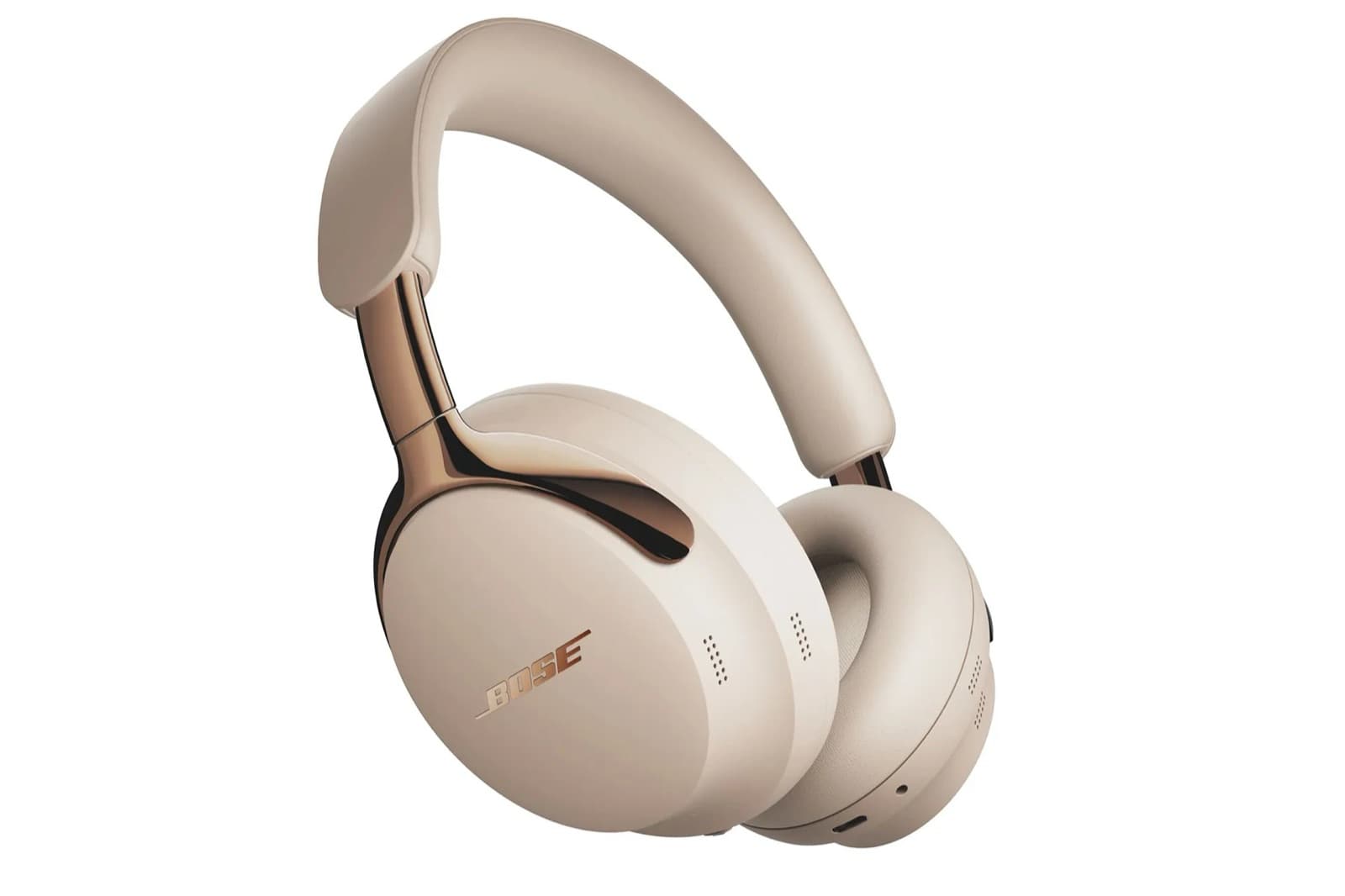
The need-to-know
Announced in early September 2025 and on shelves from the start of October, the Bose QuietComfort Ultra Headphones (2nd Gen) are the company's top over-ear model and sit above the standard QuietComfort line. They are sold in the US through Bose directly and the usual retailers, in five finishes: Black, White Smoke, Midnight Violet, Driftwood Sand and Desert Gold. This is flagship-money territory, directly against the Sony WH-1000XM6 and the Bowers & Wilkins Px7 S3. The target buyer has not changed since the first Ultra: people who fly a lot, work in noise, and rank silence above every other attribute a headphone can have.
Key specs
What the Bose QuietComfort Ultra Headphones (2nd Gen) actually give you:
- Bluetooth with SBC, AAC and aptX Adaptive, plus Bluetooth Multipoint for two devices
- Stated 30 hours with noise cancelling on, 45 hours with it off, and 23 hours when Immersive Audio is running
- USB-C port that now handles wired listening as well as charging, carrying CD-quality lossless audio
- A separate 2.5mm analog input on the left earcup
- Quiet, Aware and Immersion listening modes, plus adjustable custom modes in the Bose app
- New Cinema mode that pairs the Still spatial setting with maximum cancellation for TV and film
- Improved ActiveSense response that softens sudden noise spikes in Aware mode
- 250g, folding earcups, hard-shell carry case, capacitive touch strip for volume and shortcuts
- Five finishes, with polished mirror-finish metal yokes replacing the first model's matte ones
What is new versus the first Ultra
The list is short and pointed. Wired USB-C listening is the big one: on the original Ultra the USB-C port only charged, which meant carrying a second cable and giving up any hope of lossless playback. Battery life moves from a stated 24 hours to 30 with cancelling engaged. Cinema mode is new, bundling the Still spatial setting and the most aggressive cancellation into a single preset aimed at films and TV rather than music. ActiveSense has been retuned so Aware mode reacts more smoothly when a train passes or a machine starts up. Design-wise, almost nothing moved beyond the yokes and two new colors, which is a defensible choice given how well the shape already worked.
What it nails
Outright noise blocking remains the reason to buy. Across published reviews, the Bose QuietComfort Ultra Headphones (2nd Gen) are still credited with the most intense cancellation in the category — Sony has closed most of the gap, but Bose holds a narrow lead in its most aggressive setting, flattening engine rumble and mid-band chatter until only the sharpest high frequencies get through. Comfort is the other standout: 250g, pleather cushioning on both the pads and the headband, and a grip judged well enough to survive a head shake without clamping. Cinema mode is the first Bose spatial feature that reviewers describe as clearly worth using, pulling dialogue forward inside a wider field.
Where it trips up
Sound quality is the weak link, and not because it is bad. The 2nd Gen is tighter, cleaner and better separated than the original Ultra, with the familiar warm, punchy Bose character intact. The problem is the competition: reviewers place the Sony WH-1000XM6 clearly ahead on tonality, clarity, texture and dynamic subtlety, with Bowers & Wilkins and Sennheiser rated at least the Sony's equal. Battery also drops sharply to a stated 23 hours once Immersive Audio is on. Motion mode, which tracks your head, still draws attention to its own processing. And there is no LDAC or hi-res wireless codec despite aptX Adaptive being on board.
Buy it if, skip it if
Buy the Bose QuietComfort Ultra Headphones (2nd Gen) if your priority list starts and ends with silence, if you fly often, or if you want headphones you can wear for a transatlantic leg without your ears complaining. Buy them if USB-C lossless from a laptop matters and you would rather not carry two cables. Skip them if music quality is the deciding factor, because the Sony rival is rated meaningfully better there. Skip them if you already own the first Ultra and rarely listen wired, since the upgrade is mostly about plugging things in. And skip them if head-tracked spatial audio is a must-have feature.
Worth considering instead
The Sony WH-1000XM6 is the obvious rival and the one reviewers hand the sound crown to, with folding hinges, LDAC and Auracast, though it still refuses to do USB-C audio. Bose's own refreshed QuietComfort Headphones (2nd Gen), announced in August 2026, borrow the Ultra line's TrueSpatial immersive modes and add USB-C lossless at a lower tier, which makes them a genuinely awkward internal rival. Bowers & Wilkins offers the detail-focused alternative. And Sonos entered the premium over-ear market in September 2026 with a model built to hand audio back and forth with a Sonos soundbar.
Pros
- Still the most intense noise cancelling in an over-ear headphone
- USB-C wired listening finally arrives, carrying CD-quality lossless
- Battery up to a stated 30 hours with cancelling active
- Cinema mode makes the spatial processing genuinely useful
- Exceptionally comfortable at 250g, and the earcups fold for travel
- Five finishes, including two new colorways
Cons
- Sound quality is rated behind the Sony WH-1000XM6 and other rivals
- Immersive Audio cuts stated battery life to 23 hours
- Motion spatial mode still calls attention to its own processing
- No LDAC or hi-res wireless codec support
- Design barely moves on from the first Ultra
Comparison
Sony WH-1000XM6
The one to beat on sound. Reviewers rate it clearly ahead of the Bose for tonality, clarity and dynamics, with LDAC, Auracast and folding hinges, though it offers no USB-C wired listening at all.
Bose QuietComfort Headphones (2nd Gen)
Announced August 2026 with a new industrial design, a six-microphone cancellation system, USB-C lossless and the Ultra line's Still, Motion and Cinema spatial modes. The value pick inside Bose's own range.
Bowers & Wilkins Px7 S3
The detail-first alternative at similar money, rated by reviewers as at least the Sony's sonic equal. Choose it if build quality and fine resolution matter more to you than the very deepest silence.
Sonos Ace Ultra
Sonos's September 2026 premium over-ear, with a 40mm driver, ten-microphone adaptive cancelling, a stated 35 hours and the ability to pull sound off a Sonos soundbar at the press of a button.
FAQ
Bose announced them in early September 2025 and they reached shelves at the start of October 2025, exactly two years after the original Ultra Headphones launched. They remain Bose's flagship over-ear model in the US.
The Bose QuietComfort Ultra Headphones (2nd Gen) do exactly what a second generation should: they plug the gaps, keep the comfort and hold on to the quiet. If silence is your metric, nothing blocks more. If music is your metric, Sony has moved further in the same two years, and that is the choice in a nutshell — the world switched off, or the music switched on.