The Best Fall Jackets Right Now: Eight That Actually Work
American fall is not one season. It is a drizzly forty degrees in Portland, a bright sixty in Denver and a humid seventy-five in Atlanta until it abruptly is not. So the right jacket depends less on brand loyalty than on which of three categories you need: synthetic insulation for wet cold, down for maximum warmth per ounce, or fleece for moving around in. Below are eight current layers from Patagonia, Arc'teryx and The North Face, with published fill weights and measured jacket weights, and an honest note on what each one gives up.
How we would choose
Three questions. Is your cold wet or dry? Synthetic fill keeps insulating when soaked, while down collapses, so the Pacific Northwest and the Northeast lean synthetic and the Mountain West leans down. Will you be moving or standing still? Insulated pieces trap heat beautifully and breathe badly, so high-output activity needs either an active insulator or a fleece. And will this be your outer layer or a mid-layer? Outer layers need wind resistance and a hood that works, mid-layers need a slim cut that slides under a shell. After that, look at fill weight in grams for synthetics and fill power plus fill weight in ounces for down, because those numbers tell you far more than the name on the chest.
The everyday synthetics: Patagonia Nano Puff Hoody and Arc'teryx Atom Hoody
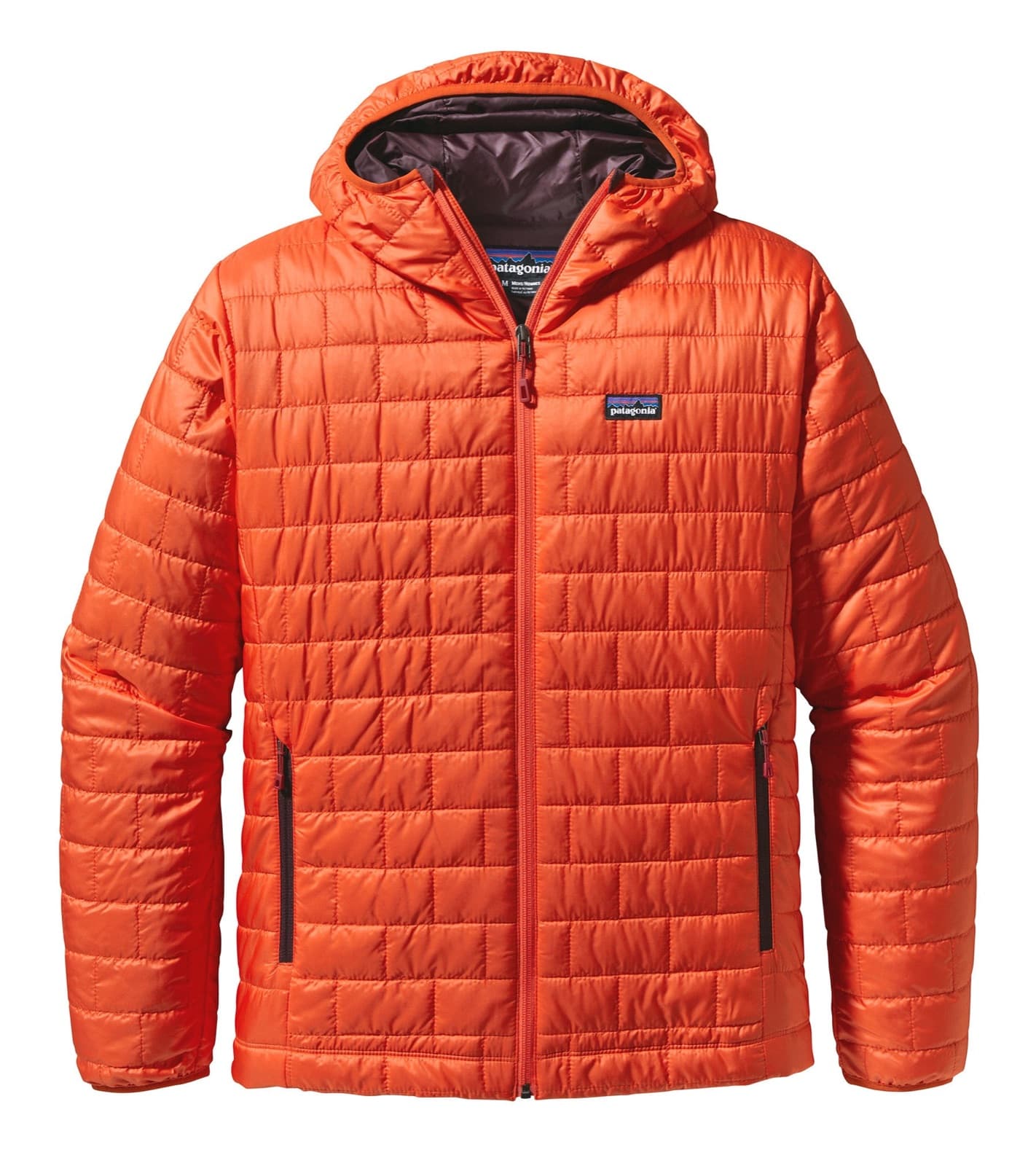
These two own the category for good reason. The Patagonia Nano Puff Hoody carries 60-gram PrimaLoft Gold Eco in a 20-denier recycled polyester shell, weighing 14.1 oz in a men's size and 12.3 oz in a women's, with a PFC-free water repellent finish, a Bluesign-approved lining and Fair Trade Certified sewing. It packs into its own chest pocket and is comfortable into the low forties. The Arc'teryx Atom Hoody uses 60-gram Coreloft Compact at 12.5 oz men's and 11.3 oz women's, with stretch side panels that make it more mobile and cooler on the move. Neither is especially breathable, and the Nano Puff hood is not adjustable.
Down for warmth per ounce: Patagonia Down Sweater and Arc'teryx Cerium Hoody
For dry cold, down still wins on weight. The Patagonia Down Sweater carries 5.0 oz of 800-fill responsibly sourced down in a men's size and 3.5 oz in a women's, weighing 13 oz and 10.3 oz respectively, in a NetPlus shell made from recycled fishing nets. It is the rare technical piece that looks right in a city, and the hooded version adds a little under two ounces. The Arc'teryx Cerium Hoody is the performance option at 11.9 oz men's and 10.2 oz women's, with 4.0 oz of 850-fill down plus 80-gram Coreloft placed in moisture-prone zones through Arc'teryx's Down Composite Mapping, and a helmet-compatible StormHood.
When it gets properly cold: Patagonia Hi-Loft Nano Puff Hoody
The gap in most wardrobes is between a 60-gram mid-layer and a full winter parka, and the Patagonia Hi-Loft Nano Puff Hoody fills it. It uses PrimaLoft Silver Insulation Eco body-mapped in 170-gram and 200-gram weights, with the heavier fill in the hood, front body and back body where you lose heat and stay still. Shell and lining are both 100 percent recycled polyester, and the face fabric is heavier and more abrasion-resistant than the 20-denier shell on the standard Nano Puff. It is windproof with a water-resistant finish, so it works as an outer layer rather than only under a shell. The cost is bulk, and it is far too warm for a mild fall.
If you keep moving: The North Face Summit Series Casaval Hybrid Hoodie and Patagonia R1 Air
Standard insulation turns you into a sauna the moment you work hard. The North Face Summit Series Casaval Hybrid Hoodie solves that with air-permeable Ventrix insulation in 60-gram and 40-gram zones, weighing 1 lb 0.6 oz in a men's size and 14.8 oz in a women's, and reviewers rate its breathability and durability at the top of the active-insulation class. The trade is weight and a little warmth. The Patagonia R1 Air Full-Zip Hoody attacks the same problem with fleece instead, using hollow-core yarns in a zig-zag pattern to trap or dump heat, at 12.9 oz men's and 10.9 oz women's. Its fabric packs out and roughens over time, which is the known flaw.
Fleece for the city: The North Face Retro Denali
Not every fall layer needs a technical justification. The North Face Retro Denali is the heavyweight fleece that has been in continuous cultural rotation since the 1990s, and it remains the pick when you want warmth, a windproof panel across the chest and shoulders, and a silhouette that reads as a jacket rather than gear. It is warmer and heavier than a performance grid fleece, which makes it worse for hiking and better for standing outside a coffee shop in November. If you want something sleeker for layering under a shell, the Arc'teryx Kyanite Hoody covers the same weight class with a much smoother exterior and a more athletic cut.
What to skip, and what to wait for
Skip buying a heavyweight puffy as your only jacket if you live anywhere south of the Mason-Dixon line, because it will sit in a closet for ten months. Skip ultralight down if you are rough on gear, since the thin shells that make those jackets light are the first thing to tear. Skip any jacket whose insulation type is not disclosed in grams or fill power, because that omission is deliberate. And if you already own a 60-gram synthetic that fits, the upgrade that actually changes your winter is a heavier insulated piece like the Hi-Loft, not another mid-layer in a new colour.
Comparison
Patagonia Nano Puff Hoody
The default fall layer. 60-gram PrimaLoft Gold Eco in a 20-denier recycled shell, 14.1 oz men's, PFC-free finish and Fair Trade sewing. Packs into its own pocket, but the hood does not adjust.
Arc'teryx Atom Hoody
The mobile synthetic. 60-gram Coreloft Compact at 12.5 oz men's, with stretch side panels that keep you cooler while moving. Trimmer cut than the Nano Puff and still limited on breathability.
Patagonia Down Sweater
The best-looking technical down piece. 5.0 oz of 800-fill down in a men's size, 13 oz total, in a NetPlus shell made from recycled fishing nets. Loses its warmth if it gets soaked.
Arc'teryx Cerium Hoody
The performance down option at 11.9 oz men's, combining 850-fill down with 80-gram Coreloft in damp-prone zones and a helmet-compatible hood. Premium price, premium finish.
Patagonia Hi-Loft Nano Puff Hoody
The winter-capable Nano Puff, with body-mapped 170 and 200 gram PrimaLoft Silver Eco, a fully recycled shell and lining, and a tougher face fabric. Bulky and too warm for mild autumns.
The North Face Summit Series Casaval Hybrid Hoodie
The active insulator. Air-permeable Ventrix in 60 and 40 gram zones at 1 lb 0.6 oz men's, with class-leading breathability and durability. Heavier than rivals and slightly less warm.
Patagonia R1 Air Full-Zip Hoody
The performance fleece. Hollow-core yarns in a zig-zag knit at 12.9 oz men's, exceptional at balancing warmth and venting. The fabric packs out and roughens with washing.
The North Face Retro Denali
The heavyweight city fleece. Warm, windproof across the chest and shoulders, and unmistakably a jacket rather than gear. Too warm and too bulky for genuine hiking.
FAQ
Synthetic if your climate is wet, because PrimaLoft and Coreloft keep insulating when damp. Down if your climate is dry and you want the most warmth for the least weight, which is where the Patagonia Down Sweater and Arc'teryx Cerium Hoody excel.
For most Americans, the Patagonia Nano Puff Hoody remains the single most useful fall jacket: warm enough, packable, repairable and fully recycled. If your fall is dry and you value weight, the Patagonia Down Sweater is the better buy. If you move fast, take the Ventrix-insulated North Face or the R1 Air. And if fall in your state is really early winter, go straight to the Hi-Loft.