Matter and the Smart Home in 2026: Cameras Finally Arrive
Matter spent its first three years being the smart home standard everyone agreed was a good idea and nobody could quite explain. In 2026 that finally started to change, and not because of a marketing push. Cameras arrived. Thread got its networking act together. Ikea flooded the low end with certified hardware. And a stubborn gap opened between what the specification can do and what the big platforms actually implement. Here is the honest state of play for a US home this year.
What Matter 1.5 actually added
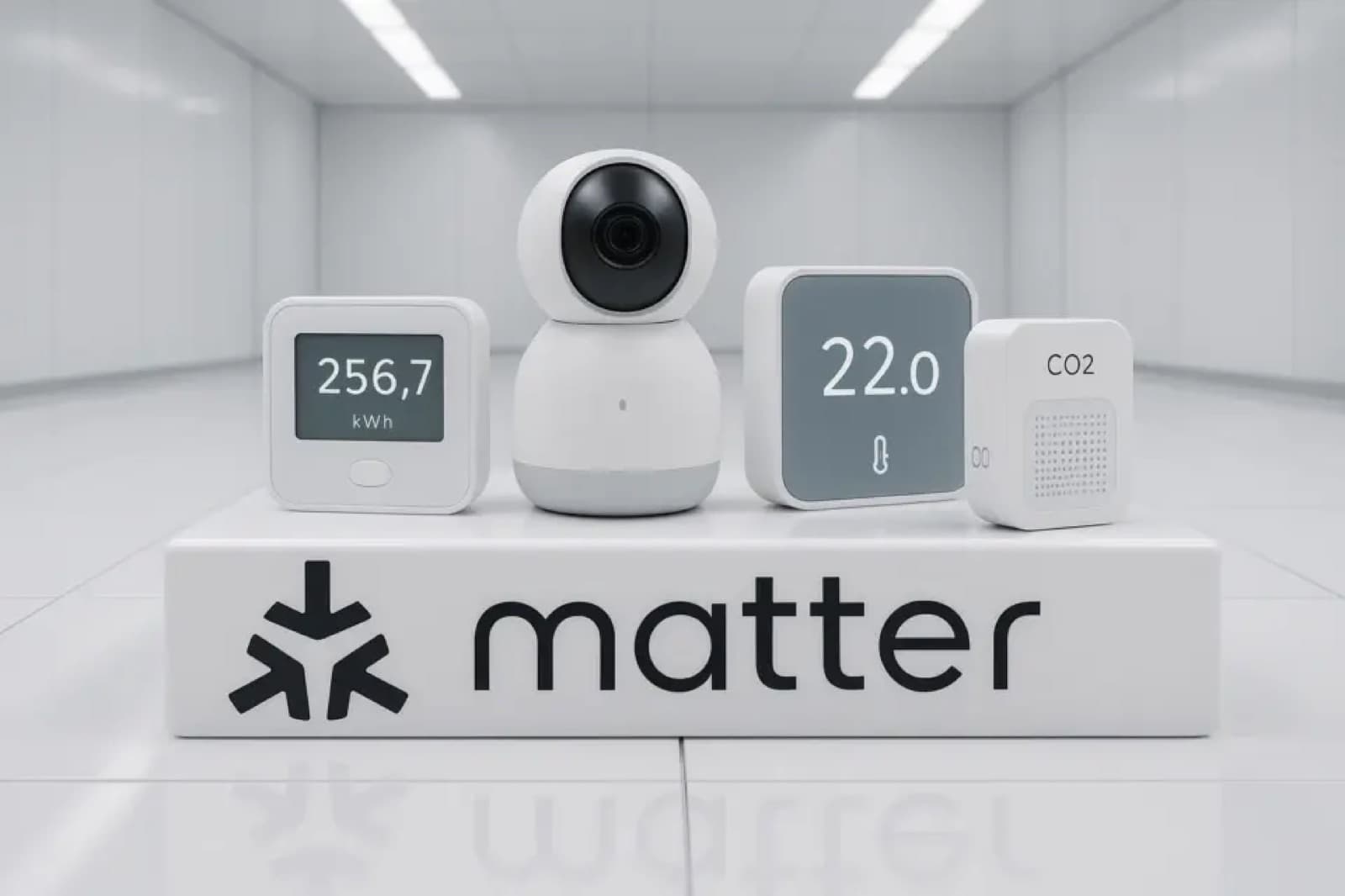
The Connectivity Standards Alliance released Matter 1.5 on 20 November 2025, following the quality-focused 1.4.1 and 1.4.2 updates. It is the biggest functional expansion since launch. Cameras are the headline: developers can now build and certify cameras that work directly with Matter ecosystems, streaming live video and audio over WebRTC with two-way communication, local and remote access via standard STUN and TURN, multi-stream configurations, pan-tilt-zoom control, detection and privacy zones, and continuous or event-based recording to local or cloud storage. A maintenance release, Matter 1.5.1, followed on 31 March 2026 to tidy up the rough edges.
Closures, soil sensors and the energy push
Cameras got the attention, but the rest of Matter 1.5 may matter more day to day. Closures were rebuilt around a unified, modular cluster design covering window shades, drapes, awnings, gates and garage doors, using a small set of building blocks to represent sliding, rotating and opening motions across single or dual panels. That finally makes the did-I-close-the-garage question answerable across brands. Soil sensors arrived for moisture and optional temperature, which becomes genuinely useful paired with Matter water valves. And energy management gained a tariff device type so utilities can push real-time pricing and grid carbon intensity into devices.
The plumbing nobody talks about: TCP and Thread 1.4
Two infrastructure changes underpin everything above. Matter 1.5 added full support for operating over TCP transport with large message handling, which is what makes video streaming and faster firmware updates practical rather than theoretical. Separately, Thread 1.4 standardized how credentials are exchanged, so a newly installed border router joins an existing mesh instead of spinning up a parallel one — historically one of the most common causes of devices dropping offline. Border router certifications under Thread 1.3 stopped being accepted at the start of 2026, and Matter 1.4.2 now requires border routers and network infrastructure managers to be Thread 1.4 certified.
Where the platforms are still behind
This is the part that frustrates people, and it is not the standard's fault. SmartThings announced full Matter 1.5 implementation within weeks of release and partnered with Aqara, Eve and Xthings to bring certified cameras to market in early 2026. Other ecosystems remain on Matter 1.2 or 1.3, and claiming support for a newer software development kit does not mean shipping everything in it. The practical result is inconsistency: Ikea's Bilresa remote does not work in Google's ecosystem, and its Klippbok water detector fails on Alexa because leak sensors are not yet supported there. Even where a device is recognized, its feature set varies by platform.
Robot vacuums are the best example of the problem
Matter 1.4 introduced a service area feature that lets you send a robot to one specific room and have it clean only there. Using it needs three things to line up: the robot certified to a recent Matter version, the platform supporting the cluster, and the manufacturer bothering to expose it. Apple Home has steered compatible robots into specific rooms since iOS 18.4, despite still missing most of Matter 1.4 elsewhere. On the hardware side, the Roborock Saros 20, Narwal Flow 2 and Ecovacs X12 OmniCyclone all ship with Matter support, which makes them among the few smart home devices where the standard demonstrably improves daily use.
How to build a Matter home that actually works
Three rules. Buy recent: devices certified under newer Matter versions behave better, particularly battery-powered ones, because sleeping device behavior was optimized in Matter 1.4 and later. The Aqara FP300 multi-sensor illustrates the current gap honestly, rated for around three years of Zigbee operation against roughly two on Thread. Second, put mains-powered Thread devices where you need coverage, because unstable meshes and poorly placed border routers make sensors wake more often and drain faster. Third, check your platform, not the box: a Matter logo tells you the device speaks the language, not that your ecosystem understands every word.
What is cooling off, and what is heating up
The hype phase is over, which is healthy. Nobody is claiming Matter will unify the smart home overnight, and the ecosystems have stopped pretending their support is complete. What is heating up is the bottom of the market: Ikea has pushed Matter-certified products to genuinely low prices and launched a Thread offensive of more than twenty new products, with Aqara, Bosch, Home Assistant, Level, Meross, Philips Hue and Yale all shipping alongside it. Professional suppliers are joining too. Independent trackers now list more than 750 Matter products, most already available. Growth is coming from below, not from the platform giants.
Pros
Cons
Comparison
Matter 1.5
Released November 2025 with camera support over WebRTC, unified closures, soil sensors, energy tariff data and TCP transport for large messages. A maintenance update, Matter 1.5.1, arrived at the end of March 2026.
Aqara FP300
A multi-sensor that supports both Zigbee and Thread, and a useful illustration of the current trade-off: roughly three years of stated battery life on Zigbee against about two years on Thread in the same hardware.
Roborock Saros 20
One of the clearest wins for the standard, shipping with Matter support alongside major voice assistants, so a platform that implements the service area feature can send it to clean a single named room.
FAQ
The specification landed in November 2025 and SmartThings committed to it quickly, partnering with Aqara, Eve and Xthings on certified cameras for early 2026. Support across other major ecosystems is slower, so check your platform before buying a camera for its Matter badge.
Matter in 2026 is no longer a promise, but it is not a finished product either. The specification has grown into cameras, closures and energy, the networking layer underneath it got materially better, and the cheap end of the market has exploded. The remaining problem is the platforms, and until they catch up, the useful advice stays the same: buy recent, and check your ecosystem before you check the logo.