Nike Pegasus 42 vs HOKA Clifton Pro: Which Trainer Wins?
These are the two biggest daily trainers in American running stores right now, and they solve the same problem in opposite ways. The Nike Pegasus 42 keeps you close to the ground and leans on a full-length Air Zoom unit for pop. The HOKA Clifton Pro puts 42 mm of supercritical foam under your heel and lets a steep rocker do the work. One is a moderate, versatile, three-width workhorse. The other is a long-run specialist with a narrow toe. Picking between them is less about which is better and more about which shape your foot and your training actually want.
The short version
If most of your running is 30 to 50 minutes at an easy pace and you want a shoe that doubles as a sneaker, take the Nike Pegasus 42. If your week is anchored by a long run and you want protection that lasts past the 90-minute mark, take the HOKA Clifton Pro. The Nike is the more versatile object and the easier thing to fit, thanks to narrow, standard and wide sizing and a moderate platform that suits new runners. The HOKA is the more capable running shoe over distance, with a taller stack, more energy return and a rocker that keeps the stride rolling when your legs stop wanting to. Neither is a speed shoe.
Geometry: moderate stack against maximal stack
The numbers tell the story before anything else does. The Nike Pegasus 42 lists roughly 37 mm at the heel and 27 mm at the forefoot for a 10 mm drop. The HOKA Clifton Pro lists about 42 mm heel and 34 mm forefoot for an 8 mm drop in the men's build, with the women's build sitting lower at around 38 mm. That extra 5 mm under the heel and 7 mm under the forefoot changes everything downstream. The Nike keeps more ground feel and a more natural, connected stride, which some runners specifically want. The HOKA isolates you from the pavement and relies on an aggressively angled Meta-Rocker to tip you forward, because at that height a flat sole would feel clumsy.
Foam and what you get back
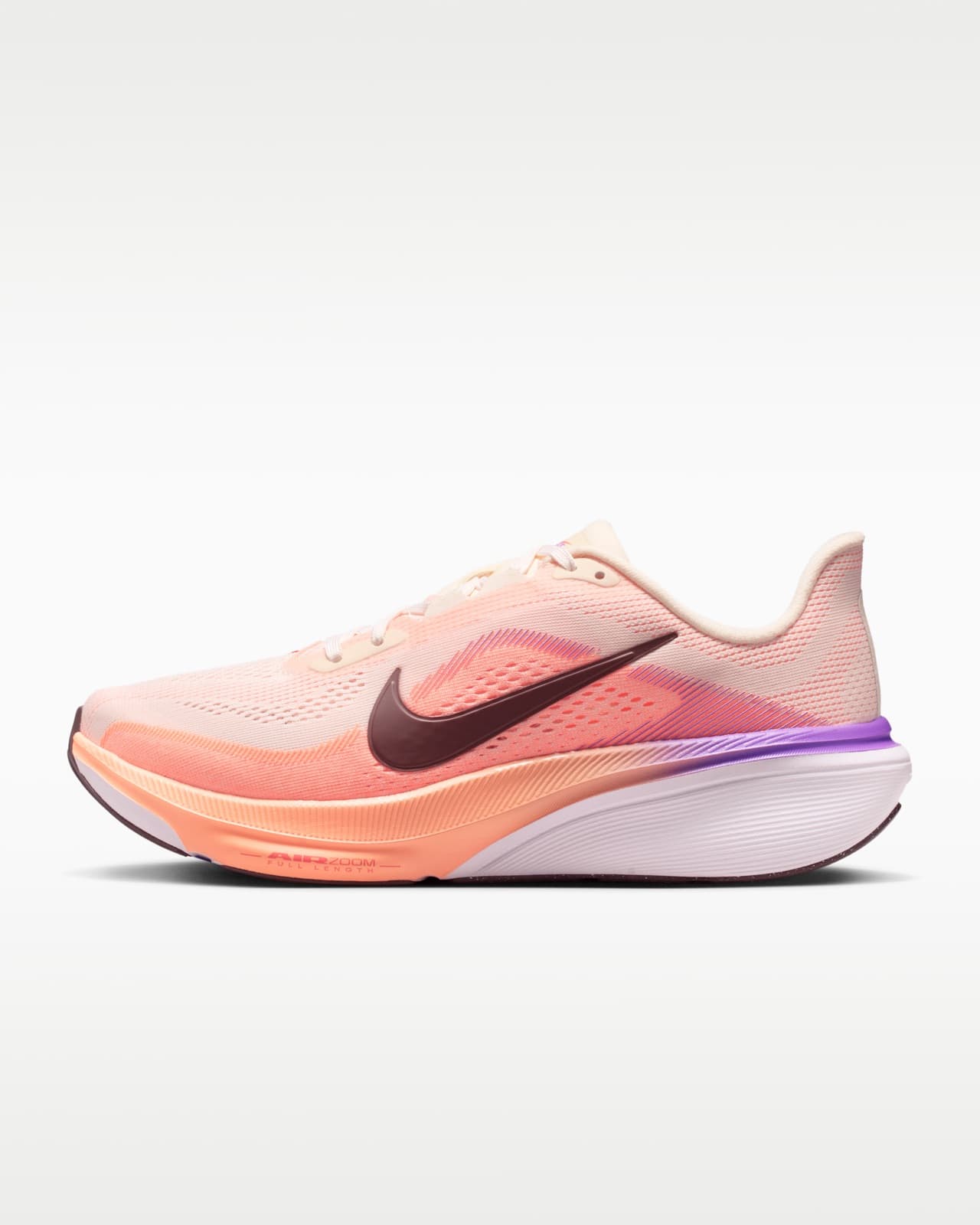
Nike uses ReactX carrying a curved, full-length Air Zoom unit, an upgrade from the two separate units in the Pegasus 41, and claims meaningfully more energy return than the previous generation. In lab terms that reads as solid heel shock absorption with only moderate rebound, and reviewers regularly note that the Nike Pegasus 42 would be transformed by a supercritical foam it does not have. HOKA went the other way, replacing the compression-molded EVA of the Clifton 11 with supercritical EVA. Independent measurement puts the HOKA Clifton Pro higher on energy return than its own predecessor while matching it on impact absorption. It is still not a PEBA-grade bounce, and reviews say so, but it is the livelier of these two.
Fit, widths and upper comfort
This is where most buyers will actually decide. Both run true to size in length. The Nike Pegasus 42 has a medium toebox that reviewers call roomier than the Pegasus 41, a soft engineered mesh and an internal midfoot support system, and Nike sells it in narrow, standard and wide. The HOKA Clifton Pro is the narrower shoe, with a more tapered and pointed toe area than the Clifton 11, enough that testers with broad forefeet report rubbing near the little toe. HOKA also offers narrow, standard and wide, so the fix exists, but you have to know to reach for it. The Clifton Pro's redesigned tongue and breathable mesh earn praise as a warm-weather pick.
Weight, grip and how long they last
Weight favours HOKA, which is not the usual outcome. Brand figures put the HOKA Clifton Pro between roughly 9.7 and 10.4 oz depending on sample, with RunRepeat's scale recording 9.3 oz, while the Nike Pegasus 42 lists around 10.5 oz with a lab weight of about 10.1 oz. The taller shoe is the lighter shoe. Grip flips the result: Nike improved the waffle outsole for this generation and testing rates its traction highly, while the Clifton Pro is repeatedly flagged for losing confidence on wet surfaces. Outsole durability is good on both. Upper durability is not, with the Pegasus toebox mesh performing poorly under abrasion testing.
Price tiers, widths and what else each brand offers
The Nike Pegasus 42 sits in the mainstream daily-trainer tier, which is the cheapest way into current Nike running technology and a real part of its appeal. The HOKA Clifton Pro is priced above the standard Clifton and above the Pegasus, positioning it as a premium long-run shoe rather than a default. Ecosystem matters too. If the Pegasus feels flat, Nike's own answer is the Pegasus Plus with full ZoomX, or the Vomero line for plusher miles. If the Clifton Pro feels too narrow or too soft, HOKA points you to the roomier Clifton 11 or the lighter, faster Mach 7. Both brands sell three widths here, which many rivals do not.
Who should pick which
Pick the Nike Pegasus 42 if you are new to running, if you want one shoe for runs and daily wear, if you need a narrow or wide fitting and appreciate a roomier toebox, or if you are a heel striker who likes a 10 mm drop. It is the safer, cheaper, more universal buy. Pick the HOKA Clifton Pro if long runs dominate your training, if you want maximum cushioning without a carbon plate, if you run in heat and want a breathable upper, or if you spend all day on your feet and want a shoe that rolls you forward rather than making you push. Wide forefeet should order the wide version or step back to the Clifton 11.
Pros
- Nike Pegasus 42: cheaper, three widths, a roomier toebox and improved wet traction
- Nike Pegasus 42: moderate stack keeps the ride natural and easy to balance on
- HOKA Clifton Pro: taller, lighter and more energetic thanks to supercritical foam
- HOKA Clifton Pro: aggressive rocker makes long efforts noticeably less tiring
Cons
- Nike Pegasus 42: heavy for its stack and limited forefoot shock absorption
- Nike Pegasus 42: ReactX is durable but not a supercritical foam
- HOKA Clifton Pro: narrow, pointed toe area and weak traction in the wet
- HOKA Clifton Pro: priced above both the standard Clifton and the Pegasus
Comparison
Nike Pegasus 42
The versatile pick. About 37 mm heel, 10 mm drop, ReactX with a full-length curved Air Zoom unit, three widths and a price that undercuts the HOKA. Best for everyday miles and everyday wear.
HOKA Clifton Pro
The long-run pick. Roughly 42 mm heel, 8 mm drop, supercritical foam and a steep Meta-Rocker. Lighter than the Nike despite the height, but narrower at the toe and weaker in the wet.
FAQ
The Nike Pegasus 42, in most cases. A moderate 37 mm stack is easier to balance on than a 42 mm platform, it costs less, and the roomier toebox and three width options make it simpler to fit correctly first time.
Two very good shoes with genuinely different jobs. The Nike Pegasus 42 is the sensible default: cheaper, easier to fit, grippier and versatile enough to be the only running shoe someone owns. The HOKA Clifton Pro is the specialist worth paying up for if you run long, run warm or want the tall, rolling ride HOKA does better than anyone. Fit decides it more often than foam does.