RGB Mini-LED TVs in 2026: The Year LCD Fought Back
For a decade the story of television was OLED slowly winning. In 2026 the LCD camp turned up with a genuinely new idea, and every major brand shipped a version of it at once. Samsung calls it Micro RGB, Sony calls it True RGB, LG calls it Micro RGB Evo, and Hisense and TCL just call it RGB Mini LED. Strip away the branding and they are all doing the same thing to the backlight — and the early results are more interesting than the usual annual brightness bump.
What RGB mini-LED actually changes
A conventional mini-LED television shines white or blue light through a quantum dot layer and a color filter to produce the picture. Every step in that chain throws away light and constrains the color gamut. An RGB mini-LED backlight replaces those white or blue emitters with independently controlled red, green and blue mini-LEDs that generate color directly. Removing the filter dependency means more light reaches your eyes and a wider slice of the color space becomes reachable. In practice that translates into two claims the brands all make: dramatically higher brightness than OLED can manage, and color volume that holds up at those brightness levels rather than washing out.
Why it arrived all at once
Three pressures converged. OLED had been getting brighter every year through tandem panel structures, which closed the one advantage LCD reliably held. Panel makers needed a new premium story above conventional mini-LED, which has been commoditizing fast at every screen size. And the huge-screen market — 98 inches and beyond — is simply not served by OLED manufacturing. The first RGB sets reflected that: Samsung and Hisense both launched the technology at 115 and 116 inches respectively, sizes that exist mainly to prove a point. It took the 2026 model year for the idea to reach screen sizes people actually buy.
Who is doing it well: the mainstream sets
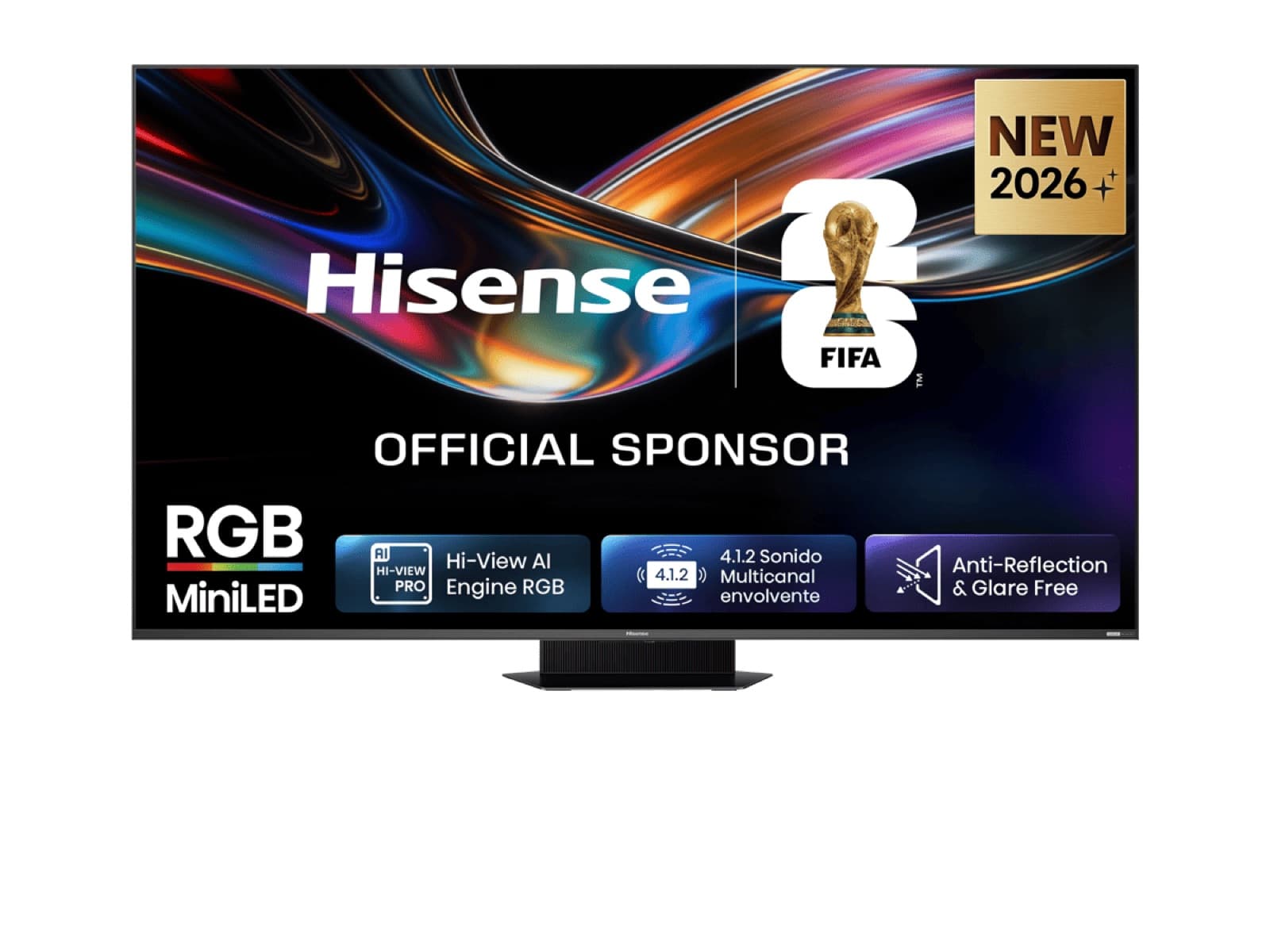
The Hisense UR9 is the first RGB mini-LED television most American buyers will seriously consider. It uses 980 local dimming zones, claims up to 3,500 nits and measured around 3,345 nits in Filmmaker Mode with 91.5 percent BT.2020 coverage and 99.4 percent of DCI-P3. Reviewers note how rarely it behaves like a backlit set: blooming is well controlled, black depth is strong and the dimming system does not draw attention to itself. It also carries an 80W Devialet-tuned 4.1.2 speaker array, a 180Hz panel and a Dolby Vision 2 Max update scheduled for late 2026. Off-axis uniformity is the main weakness.
Who is doing it well: the premium end
Samsung's 4K Micro RGB range is led by the Samsung R95H, in 65, 75 and 85 inches, with a dedicated Micro RGB AI Engine Pro, Micro RGB Precision Color processing, Wireless One Connect and 4K gaming at up to 165Hz. The step-down Samsung R85H uses the standard engine and a 144Hz panel but stretches to 100 inches, and is the cheapest way into the technology from Samsung. Sony went widest: the Sony Bravia 9 II tops the range in 65 to 115-inch sizes and was developed against Sony's own mastering monitor, while the Sony Bravia 7 II brings True RGB down to 50 inches. LG joined with the MRGB95 in 75, 86 and 100 inches.
The trade-offs nobody puts on the box
Three caveats matter. First, this is still LCD: viewing angles are narrower than OLED, and demanding scenes can still expose the limits of even an advanced dimming implementation. Reviewers who compared directly report the best OLEDs still produce a more solid, perceptually three-dimensional image. Second, connectivity has not kept pace with the panels — the Sony Bravia 9 II and Bravia 7 II both ship with only two HDMI 2.1 ports, one doubling as the eARC output, which is meager at flagship level. Third, brightness claims and measured brightness diverge wildly between brands and picture modes, so the headline nit figure deserves skepticism.
How to try it without overpaying
There is a cheaper route, and it is not RGB at all. TCL took a different path with Super Quantum Dots, refining the quantum dot layer with a five-nanometer color filter rather than rebuilding the backlight. The TCL QM8L measured roughly 4,500 nits at peak on some tests and 89.3 percent BT.2020, with four HDMI 2.1 ports, 144Hz gaming plus 1080p at 288Hz, wide viewing angles and effective anti-glare. Reviewers rate its subjective picture as a close match for RGB rivals, and its off-axis behavior and glare rejection as better. If the technology label matters less than the result, that is the value play.
What is cooling off
Two things are losing momentum. Conventional 8K is quietly shrinking: Samsung's flagship 8K Neo QLED remains in the range but Micro RGB has taken over as the premium LCD story, and native 8K content is still nowhere. And the era of the huge, technology-demonstrating flagship that nobody buys looks to be ending — the interesting RGB sets in 2026 are the 55 to 85-inch models, not the hundred-inch halo pieces. Meanwhile OLED is not going anywhere: the brightest OLEDs now measure comfortably past 2,400 nits, which keeps them competitive in exactly the rooms RGB was meant to win.
Pros
Cons
Comparison
Hisense UR9
The mainstream entry point to RGB mini-LED, with 980 dimming zones, measured brightness around 3,345 nits, 91.5 percent BT.2020 coverage and Devialet-tuned audio. Off-axis uniformity and only three HDMI 2.1 ports are the compromises.
Samsung R95H
Samsung's 4K Micro RGB flagship in 65, 75 and 85 inches, with the Micro RGB AI Engine Pro, Wireless One Connect, a 4.2.2-channel 70W system and 4K gaming at up to 165Hz across the full feature set.
Sony Bravia 9 II
Sony's True RGB flagship, developed against its own mastering monitor and stretching to 115 inches, with a 2.2.2-channel Acoustic Multi-Audio Plus array. Held back by just two HDMI 2.1 ports at this level.
TCL QM8L
Not RGB at all, but Super Quantum Dots with a five-nanometer filter. Very high measured brightness, four HDMI 2.1 ports, wide viewing angles and a Dolby Vision 2 Max update make it the pragmatic alternative.
FAQ
No, and the naming is unhelpful. Micro RGB is an LCD television with red, green and blue mini-LEDs in the backlight. Micro LED is a self-emissive technology with no LCD layer at all, sold at vastly higher prices in modular form.
RGB mini-LED is the most substantial change to LCD televisions in years, and 2026 is the year it stopped being a trade-show curiosity. The Hisense UR9 proves it works at a sane size, Samsung and Sony are pushing it upmarket, and the technology genuinely solves the brightness problem. It has not solved viewing angles, and OLED has not conceded. Watch this fight rather than betting on it.