Valve Steam Machine Review: A Console-Shaped PC, At Last
Valve tried this once before and failed badly. The 2015 Steam Machine was a specification handed to other manufacturers, and nobody wanted it. This one Valve built itself: a 156mm aluminium-and-plastic cube that boots straight into SteamOS, sits under a television and behaves like a console. Announced in November 2025, delayed by the memory shortage, and finally released on June 29, 2026 through a randomised reservation queue, the Steam Machine is the most interesting piece of gaming hardware in the US this year. Here is the intel.
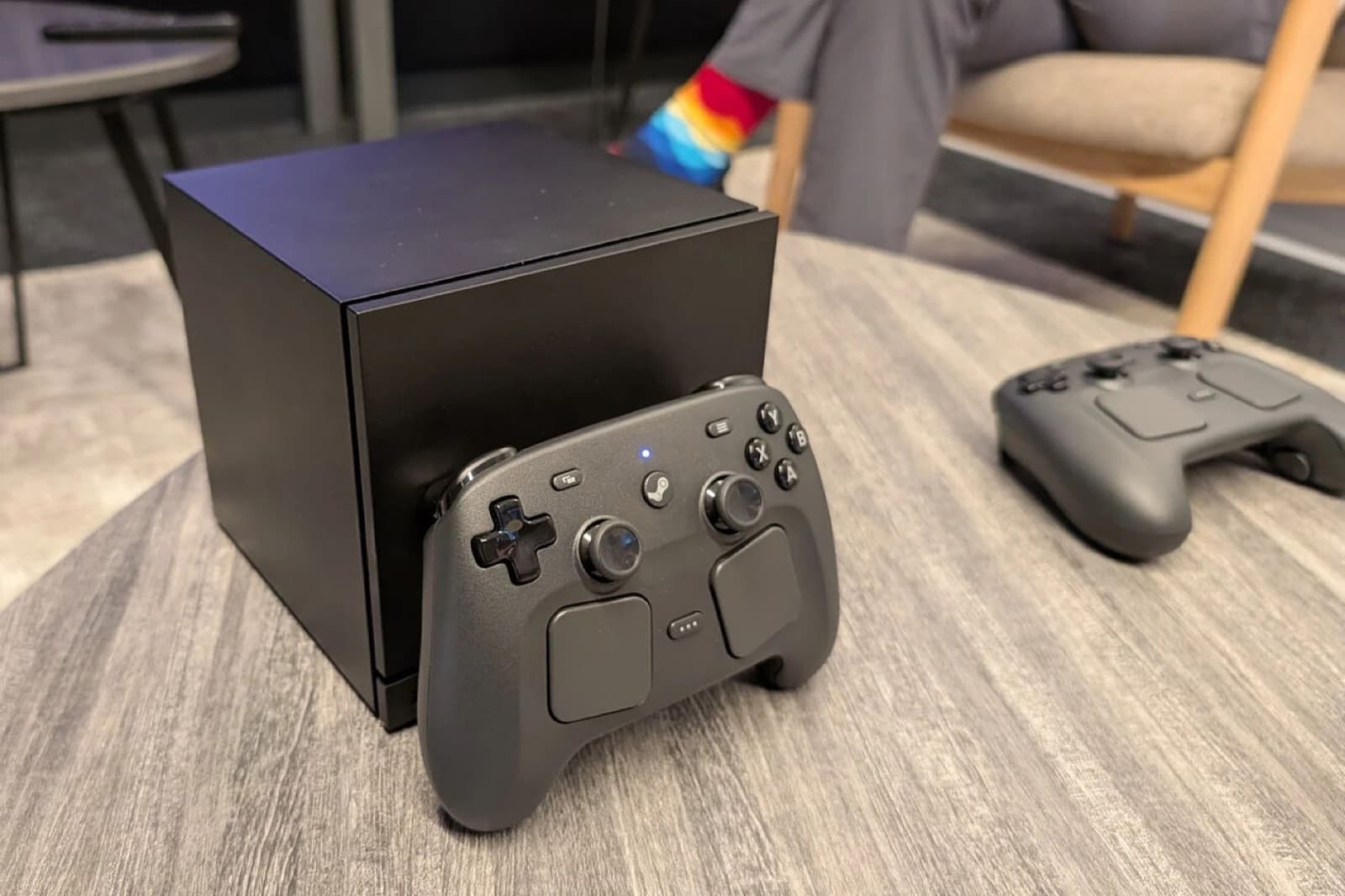
The need-to-know
The Steam Machine is a small-form-factor gaming computer built and sold by Valve, running SteamOS 3.x and the Steam storefront. It shipped on June 29, 2026 in two storage configurations, 512GB and 2TB, with bundles that add the second-generation Steam Controller. Valve opened reservations on June 22 and used a randomised draw for order slots to blunt scalping, which did not entirely work; reservation slots turned up on auction sites anyway. Pricing landed well above what Valve originally targeted, and the company was unusually candid about why: memory vendors set the price and the AI data-centre build-out set the demand. Community members immediately nicknamed the cube the GabeCube, which tells you what it looks like.
Key specs, verified
- Size and weight: 156 x 152 x 162mm, around 2.6kg, built around a single 120mm fan
- CPU: semi-custom AMD Zen 4, 6 cores and 12 threads, boosting to 4.8GHz, closest to a Ryzen 5 7540U
- GPU: semi-custom AMD RDNA 3, 28 compute units at a 2.45GHz sustained clock, with 8GB of dedicated GDDR6
- Memory: 16GB DDR5 in SO-DIMM slots, user-upgradeable
- Storage: 512GB or 2TB NVMe, expandable via 2230 or 2280 drives plus a microSD slot
- Video out: DisplayPort and HDMI
- Networking: gigabit ethernet, Wi-Fi 6E, Bluetooth, and a dedicated radio for the Steam Controller
- Ports: four USB-A and two USB-C
- Front panel: a customisable 17-segment LED bar and a removable, replaceable bezel
- Software: SteamOS 3.x with Proton; Windows drivers released after launch, though dual-boot is not yet supported
The 4K claim that did not survive
At announcement, Valve said the Steam Machine would hit 4K at 60 frames per second with FidelityFX Super Resolution and ray tracing active, and called it around six times the power of a Steam Deck. Just before release the specification page quietly changed to up to 4K gaming with FSR 4.1, and the ray-tracing language went away. Reviewers had already found the original claim achievable only with heavy per-game tuning. Journalists broadly place the hardware alongside the ninth-generation consoles, between a PlayStation 5 and an Xbox Series S, and the consensus is that this machine is happiest at 1440p with upscaling, internally scaling up for 4K panels. Buy it for 1440p and you will be pleased; buy it for native 4K and you will not.
What the Steam Machine nails
Silence, mostly. Review after review returns to how quiet this thing is, which is genuinely difficult engineering in a cube this small, and it matters enormously in a living room. The 8GB of dedicated GDDR6 alongside 16GB of system memory is a smarter split than the shared pools in comparable handhelds, and it shows in texture-heavy games. SteamOS has matured to the point where setup feels console-like: link an account, pair a controller, play. The Steam Machine is also properly serviceable, with upgradeable SO-DIMM memory, standard NVMe slots and a microSD reader, none of which a console gives you. The replaceable front bezel and configurable LED bar are small delights.
Where it trips up
Price is the universal criticism, and it is not close. Reviewers who liked the hardware still concluded that the value case collapses against a PlayStation 5 or a self-built mini PC, and third-party manufacturers largely could not match Valve's configuration at all because of the same memory costs. There is no frame generation, which would have papered over a lot at 4K. Ray tracing is beyond it in demanding titles. Performance in busy multiplayer scenes can sag hard, with reviewers reporting dips into the twenties in dense areas of some MMOs. Steam Controller button prompts are inconsistently supported across games. And SteamOS still has a compatibility ceiling: games with certain anti-cheat systems will not run at all.
Buy it if, skip it if
Buy the Steam Machine if you already own a large Steam library, want it on a television without a Windows tower in the room, and value silence and serviceability. It is the best expression yet of the console-PC idea, and the Steam Deck verification programme carries over so you can see what will run before you buy. Skip it if you are cross-shopping consoles purely on cost per frame, because a PlayStation 5 wins that argument comfortably. Skip it if you play competitive shooters with kernel anti-cheat. And skip it if native 4K was the promise you were buying, because Valve itself has now rewritten that line.
Pros
- Near-silent under sustained gaming load, which is rare in a case this small
- 8GB of dedicated GDDR6 alongside 16GB of upgradeable DDR5 system memory
- User-serviceable: SO-DIMM memory slots, standard 2230 and 2280 NVMe, and a microSD reader
- SteamOS 3 setup is genuinely console-like, and Deck-verified games carry over
- Customisable 17-segment LED bar and a removable front bezel
- Windows drivers released after launch for anyone who wants to wipe SteamOS
Cons
- Costs far more than Valve originally targeted, which dominates every review verdict
- No frame generation support, and ray tracing is out of reach in demanding titles
- Native 4K marketing was walked back to upscaled 4K days before release
- Frame rates can dip sharply in dense multiplayer scenes
- SteamOS still cannot run titles with certain kernel anti-cheat systems
Comparison
Steam Deck
The handheld that made SteamOS credible, and still the cheaper way into the same library. Weaker silicon and a small screen, but it travels, and it shares microSD cards with the Steam Machine.
PlayStation 5
Comparable raw performance, a far lower outlay and a first-party catalogue Valve cannot match. The default recommendation for anyone who just wants a box under the television.
Steam Controller
Valve's second-generation pad uses tunnelling magnetoresistive sticks that resist drift and connects over a dedicated radio. Sold separately or bundled, and the natural companion for this hardware.
A self-built SteamOS mini PC
SteamOS 3.8 installs on non-Valve hardware, and vendors and enthusiasts have assembled equivalent systems for less. More work, less polish, but the same software experience.
FAQ
Valve announced it on November 12, 2025, opened reservations on June 22, 2026, and began shipping on June 29, 2026 through a randomised draw designed to reduce scalping of early order slots.
The Steam Machine is the console-PC hybrid Valve has been chasing for a decade, and the engineering is excellent: quiet, compact, serviceable and backed by a SteamOS that finally works. The problem is arithmetic. A memory shortage pushed it far past its intended price, and at this level the comparison to a PlayStation 5 is brutal. Buy it for the library and the living-room silence, not for the value.